



New membrane with one-nanometer pores aims to improve water filtration

9 reported
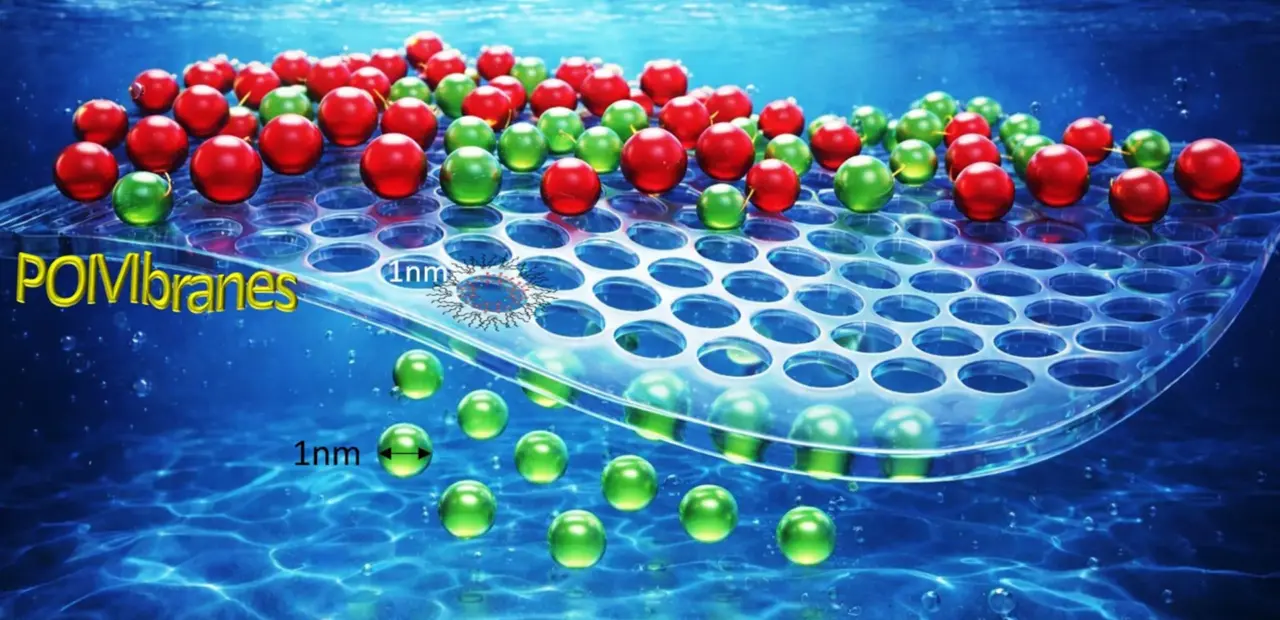
A team of researchers from India, Singapore, and the S N Bose National Centre for Basic Sciences has developed a new filtration membrane called a "POMbrane" with pores that are exactly one nanometer wide. The study, published in the Journal of the American Chemical Society, describes a technology that could help industries cut energy use and increase water reuse. The membranes are inspired by biological systems such as aquaporins and use polyoxometalate (POM) clusters that contain a naturally occurring, permanently stable opening. Testing showed the membranes can distinguish between molecules differing by only 100-200 Daltons, with researchers reporting nearly ten times better separation performance compared to existing technologies. The membranes are described as flexible, stable across different acidity levels, and scalable for large-sheet manufacturing. Potential applications include textile dye removal and water recycling, as well as pharmaceutical drug purification and solvent recovery.
What’s reported
The membrane is called a "POMbrane" and uses polyoxometalate (POM) clusters with a permanent one-nanometer hole.
The study was published in the Journal of the American Chemical Society.
Researchers came from CSIR-Central Salt and Marine Chemicals Research Institute (CSMCRI), Indian Institute of Technology Gandhinagar (IITGN), Nanyang Technological University in Singapore, and the S N Bose National Centre for Basic Sciences.
The membranes can distinguish between molecules that differ by only 100-200 Daltons.
Researchers report "almost ten times better separation performance compared to existing technologies."
The membranes are flexible, stable across different pH ranges, and can be manufactured in large sheets.
Potential applications include textile dye removal, water recycling, and pharmaceutical drug purification.
India's textile and apparel sector contributes more than 2.3% of GDP and represents approximately 13% of industrial production.
The domestic textile market is currently valued at $160-225 billion and is expected to expand to $250-350 billion by 2030.
Key figures
Dr. Shilpi Kushwaha, Senior Scientist at CSMCRI
Ms Priyanka Dobariya, CSMCRI research scholar and co-first author of the article
Dr. Raghavan Ranganathan, Associate Professor at IITGN's Department of Materials Engineering
Mr. Vinay Thakur, PhD scholar at IITGN and co-first author of the article
Dr. Ketan Patel, Principal Scientist at CSMCRI
Sources: ScienceDaily