



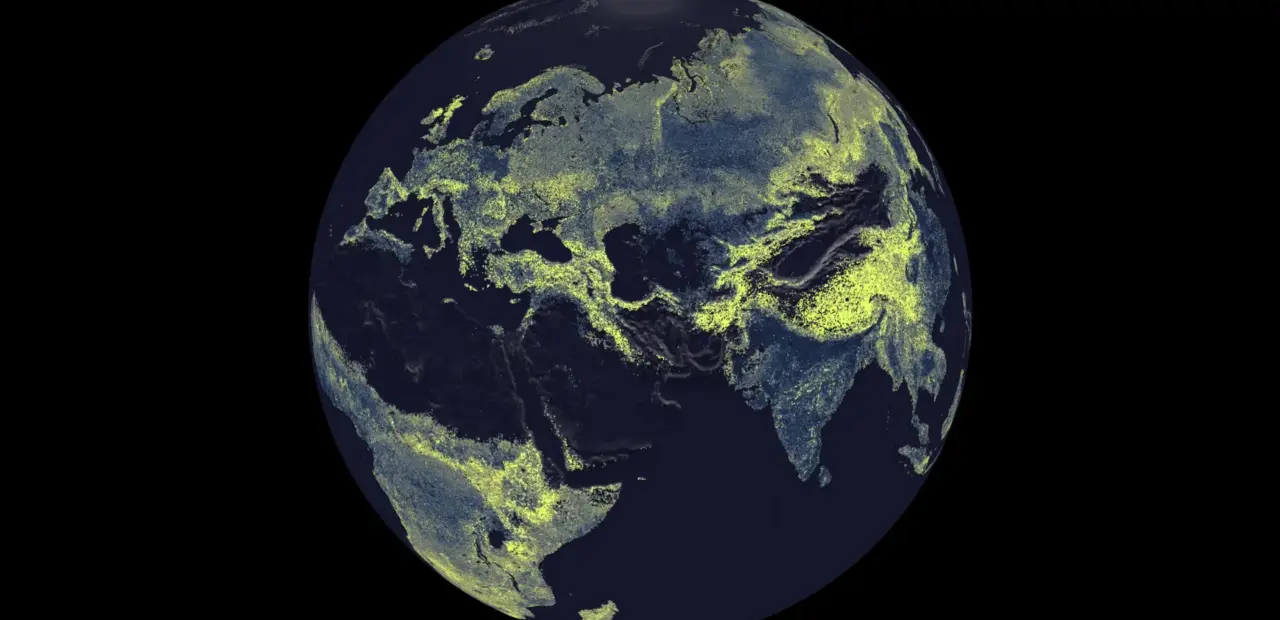
Global map of underground fungal networks reveals 110 quadrillion kilometers of threads

6 verified1 unconfirmed2 contested
Researchers have produced the first global map of arbuscular mycorrhizal fungal networks, which form symbiotic relationships with most plant species. The study, published in the journal Science, estimates the total length of these underground fungal threads at 110 quadrillion kilometers. The networks play a key role in moving carbon into soils and are densest in grasslands, while agricultural croplands show lower network densities. The mapping effort involved compiling soil samples and using machine learning to predict fungal distribution worldwide. The findings aim to help scientists and policymakers understand where these fungal systems are thriving and where they may be under threat.
What’s verified
Researchers created the first global map of arbuscular mycorrhizal fungal networks.
The networks are estimated to stretch 110 quadrillion kilometers (68 quadrillion miles).
These fungi form mutually beneficial relationships with most plant species, with sources giving figures of 70 to 80 percent.
The networks help move carbon into soils and sequester it underground.
Grasslands contain a large proportion of the global fungal network.
Agricultural croplands are predicted to have lower network densities than wild ecosystems.
Where accounts differ
One source states that arbuscular mycorrhizal fungi form relationships with roughly 70 percent of plant species, while another source states roughly 80 percent.
One source reports that the fungal networks move the equivalent of about 4 billion tons of carbon dioxide into soils annually. Another source reports that they sequester 1 billion tons of carbon underground each year. (These figures may describe the same quantity in different units, but the sources do not clarify the conversion.)
Not yet confirmed
The exact number of soil cores used (one source says more than 16,000). The use of robotic imaging to analyze fungal hyphae and the creation of an interactive visualization map are mentioned by only one source. Specific details about the proportion of network density in croplands (one source says about 50 percent lower) and the rate of grassland conversion to agriculture also come from a single source. The lead author, Dr. Justin Stewart, is named in only one source.
Key figures
Dr. Toby Kiers – executive director of the Society for the Protection of Underground Networks (SPUN) and co-author of the study.
Dr. Justin Stewart – lead author of the study (named in one source).
James Bever – professor of ecology and evolutionary biology at the University of Kansas, not involved in the study (quoted in one source).
Sources: ScienceDaily, Ars Technica