



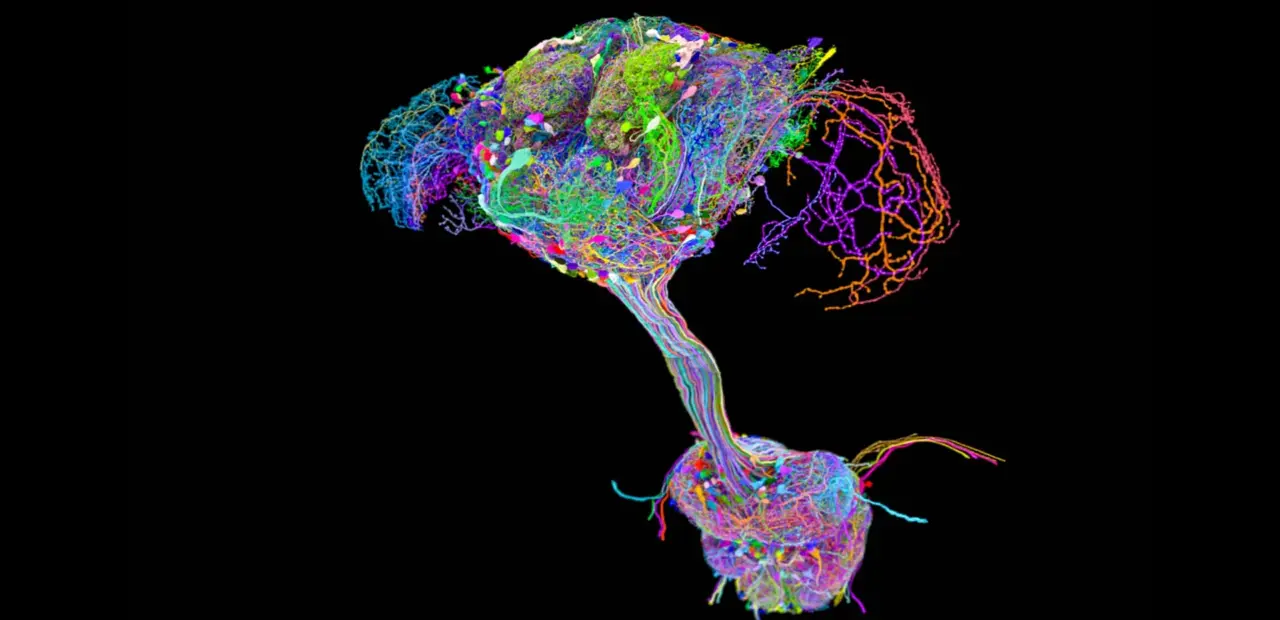
Fruit fly neural map reveals distributed motor control

5 reported
Scientists have completed the first full brain-to-body wiring map of an adult fruit fly, according to a study published June 8 in Nature. The map, known as a connectome, covers every neural connection in the fly’s central nervous system, including the brain and the nerve cord, which is the fly’s equivalent of a spinal cord. The research was led by teams at Harvard Medical School and Princeton University, with support from U.S. federal funding including the BRAIN Initiative. When the team studied the connectome, they found that many fruit fly behaviors appear to be directed by local neural circuits in relevant body parts rather than by a single central command area in the brain. For example, movement of one leg is mainly governed by the neural circuits for that leg, which then communicate with circuits for other legs to produce coordinated actions like walking. The full connectome is now freely available online for researchers worldwide.
What’s reported
The connectome maps every neural connection in the central nervous system of an adult fruit fly.
The map extends a previously published fruit fly brain connectome by adding the nerve cord.
The study was published June 8 in Nature.
Researchers found that motor control in fruit flies mostly occurs locally, not from a central brain command center.
The connectome is freely available online.
Key figures
Rachel Wilson, study co-senior author, Joseph B. Martin Professor of Basic Research in Neurobiology at Harvard Medical School
Wei-Chung Allen Lee, study co-senior author, associate professor of neurobiology at HMS and HMS professor of neurology at Boston Children’s Hospital
Helen Yang, co-first author, research fellow in neurobiology in the Wilson Lab
Alexander Bates, co-first author, research fellow in neurobiology in the Wilson Lab
Mala Murthy, co-senior author, Karol and Marnie Marcin ’96 Professor of Neuroscience at Princeton and director of the Princeton Neuroscience Institute
Arie Matsliah, co-author, Princeton Neuroscience Institute
Sources: ScienceDaily