



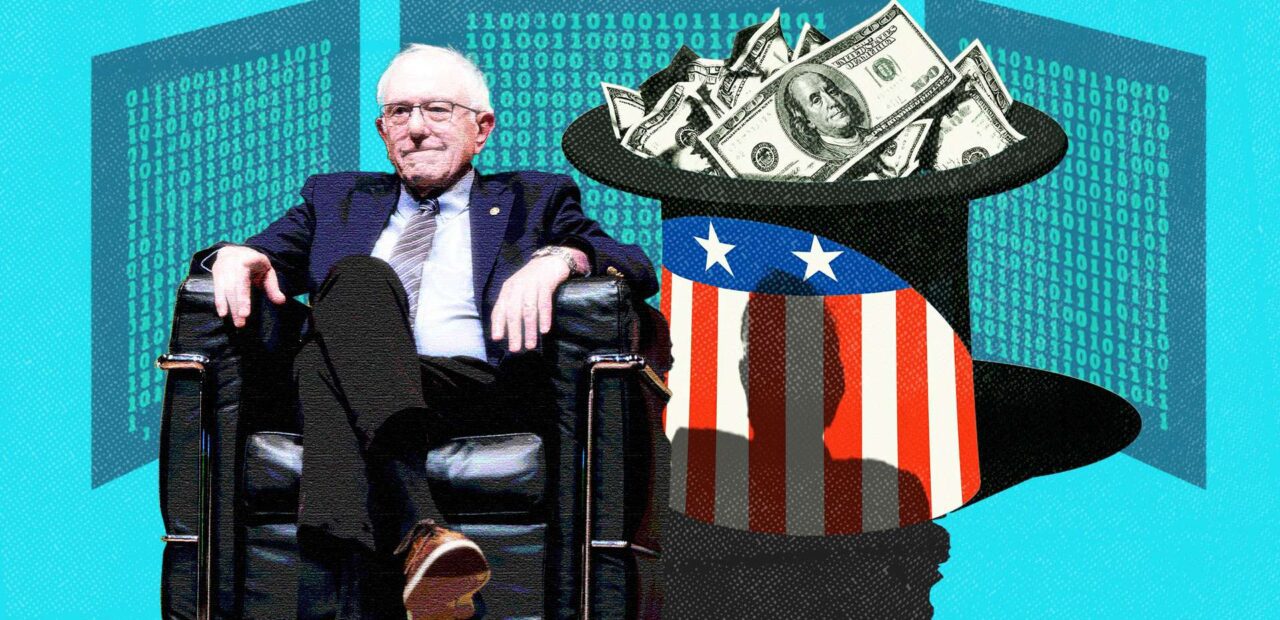
Sanders Proposes 50% AI Stock Tax for Sovereign Wealth Fund

6 verified4 unconfirmed1 contested
Sen. Bernie Sanders (I-Vt.) has introduced legislation that would impose a 50 percent tax on artificial intelligence companies, paid in stock, to create a federal sovereign wealth fund. The American A.I. Sovereign Wealth Fund Act applies to AI companies with more than $200 million in annual sales. Under the bill, the government would take a 50 percent ownership stake in the affected firms through newly issued shares. Proceeds from the fund would be used to pay annual dividends to every U.S. resident, with Sanders estimating initial payments of about $1,000 per person. The bill also requires AI companies to structurally separate their AI and non-AI operations. The idea of publicly sharing AI profits has drawn support from President Donald Trump and some industry leaders, though Sanders acknowledged the bill is unlikely to become law under Republican control of Congress.
What’s verified
The bill, titled the American A.I. Sovereign Wealth Fund Act, imposes a 50% tax on AI companies with more than $200 million in annual sales, paid in stock.
The resulting sovereign wealth fund would pay dividends to taxpayers, with Sanders estimating initial annual payments of about $1,000 per person.
The legislation requires companies to structurally separate their AI and non-AI business lines.
The fund would be overseen by a seven-member board, though sources differ on how board members are selected.
President Donald Trump has expressed support for the concept of the federal government taking stakes in AI companies.
Industry support for the general idea includes remarks from Anthropic CEO Dario Amodei and a plan from OpenAI for a public wealth fund.
Where accounts differ
One source reports that the seven-member board would consist of "seven presidentially appointed commissioners nominated by congressional leadership," while another source states the board is "appointed by the president and confirmed by the Senate." The sources do not reconcile these details.
Not yet confirmed
According to a single report, the tax applies to gross receipts rather than revenue, and it would also apply to companies like Tesla, Waymo, Nvidia, and Dell. The same source states the bill overrides corporate charter limits and bars companies from joint ventures or sharing personnel with non-AI firms.
Another report says the bill contains rules to prevent companies from moving offshore to avoid the tax and prohibits the fund from selling its stocks.
Sanders reportedly said he has not spoken with the White House about the bill but is in conversation with other senators.
The exact date of the bill's introduction is not specified beyond "Thursday," with some sources referencing June 18 and others June 19, 2026.
Key figures
Sen. Bernie Sanders (I-Vt.) – bill sponsor
President Donald Trump – expressed support for government stakes in AI
Dario Amodei – CEO of Anthropic, acknowledged need for income support
Sam Altman – CEO of OpenAI, met with Sanders; OpenAI released a plan for a public wealth fund
Sources: reason.com, rollcall.com