



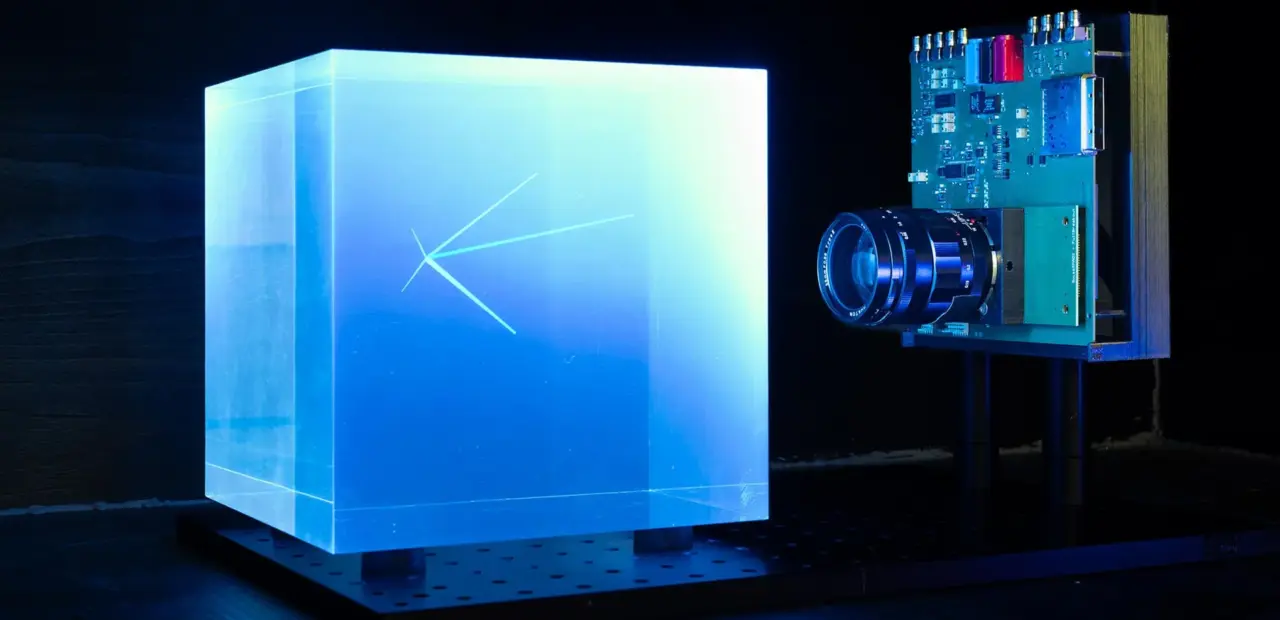
New camera tracks invisible particles in 3D using light-field technology

7 reported
Researchers at ETH Zurich and EPFL have developed and tested a prototype particle detector called PLATON that uses a light-field camera, highly sensitive photon sensors, and artificial intelligence to reconstruct particle paths in three dimensions. Instead of dividing the detector into millions of tiny units, the system uses a micro-lens array and a single-photon avalanche diode (SPAD) imaging sensor known as SwissSPAD2 to capture the direction and timing of faint light from a scintillator block. The prototype was described in Nature Communications, and simulations suggest the technology could match or surpass today’s best detectors while being easier to scale. The team also filed three patents for using PLATON technology in positron emission tomography (PET) medical scans. The project is funded by the Swiss National Science Foundation.
What’s reported
The PLATON detector combines a micro-lens array with a SPAD imaging sensor (SwissSPAD2) to capture light direction and depth.
The prototype was tested with light levels ranging from several hundred detected photons down to only five.
Electrons from a strontium-90 source were used to test the detector’s ability to reconstruct positions inside a plastic scintillator block.
Simulations indicate an unsegmented (10x10x10)cm3 PLATON detector could achieve spatial resolution below 1mm.
For a one-cubic-meter block, simulations suggest spatial resolution of a few millimeters, comparable to state-of-the-art plastic scintillator detectors.
Three patents have been filed for PLATON technology in PET medical imaging.
The project is funded by the Swiss National Science Foundation and involves researchers from ETH Zurich and EPFL.
Key figures
Till Dieminger, PhD student at ETH Zurich
Dr. Saúl Alonso-Monsalve, senior scientist at ETH Zurich
Professor Davide Sgalaberna, ETH Zurich
Professor Edoardo Charbon, EPFL
Raytrix GmbH (designed the micro-lens array)
Sources: ScienceDaily