


Interstellar comet 3I/Atlas may be oldest object seen in solar system, study says

8 reported1 unconfirmed
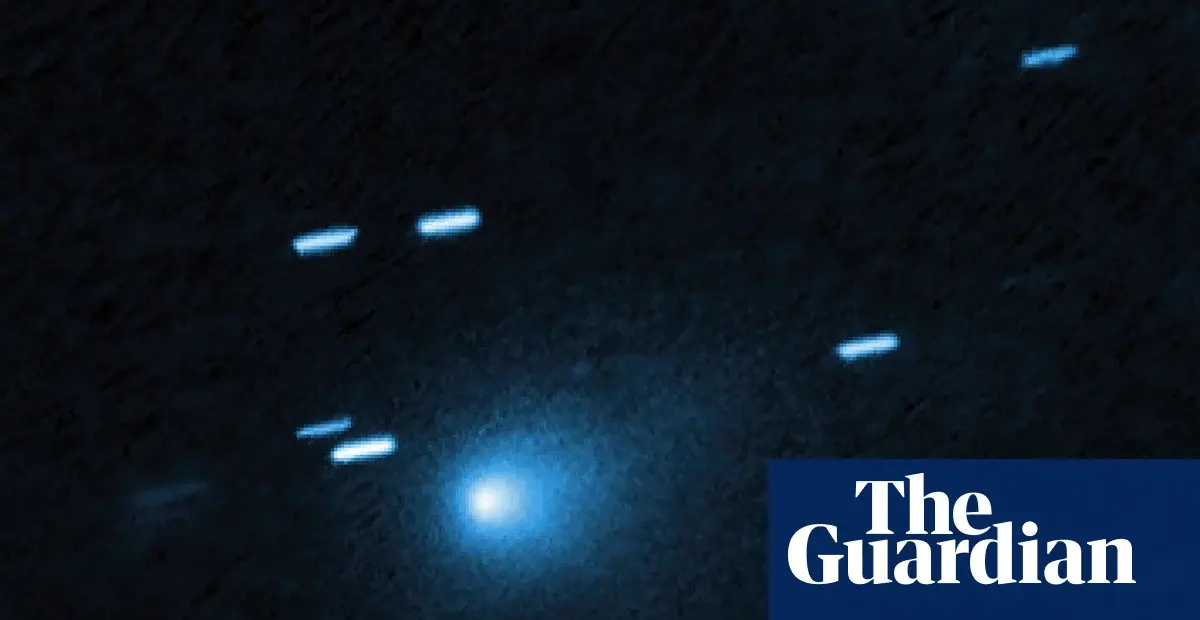
A study published in the journal Nature reports that the interstellar comet 3I/Atlas, which passed the sun last year, could be up to 12 billion years old — nearly three times older than our solar system. The comet is only the third interstellar object observed by humanity, and its unusual brightness allowed scientists to gather isotopic data using the James Webb space telescope and the Alma observatory in Chile. The lead study author, Martin Cordiner of NASA’s Goddard Space Flight Center, said it “maybe it’s the oldest object to have been observed in our solar system,” though he noted “edge-case scenarios” could offer other explanations. The comet has 10 times more deuterium than solar system comets, indicating it formed in a very cold environment of -243C. The study also found a strange lack of chemical enrichment, suggesting the comet formed relatively close to stars being born and could be a relic from “cosmic noon” about 10 billion years ago. The comet is now leaving the solar system and will never return, according to astronomer Peter Vereš.
What’s reported
The comet 3I/Atlas is the third interstellar object ever observed by humanity.
It was spotted in July last year and prompted online speculation, including from Harvard researcher Avi Loeb, that it could be an alien spacecraft — a theory NASA dismissed.
The study in Nature says the comet could be up to 12 billion years old; the solar system formed about 4.5 billion years ago.
The comet has 10 times more deuterium than solar system comets, indicating formation in a very cold environment (-243C).
The comet shows a lack of chemical enrichment, suggesting it formed near stars being born and could be a relic from “cosmic noon” about 10 billion years ago.
The previous interstellar objects, 1I/’Oumuamua (2017) and 2I/Borisov (2019), were not bright enough for isotopic evidence.
The Search for Extraterrestrial Intelligence Institute (Seti) found “no evidence of extraterrestrial technology” on the comet.
Astronomers expect to spot more interstellar objects with the new Vera C Rubin observatory in Chile.
Open questions
Exactly where within the Milky Way the comet originated remains a mystery.
Key figures
Martin Cordiner, lead study author, NASA’s Goddard Space Flight Center
Avi Loeb, Harvard professor
Peter Vereš, astronomer, International Astronomical Union’s Minor Planet Center
Sources: The Guardian