

Giant fire tornadoes shown to burn oil spills faster with less pollution

6 reported
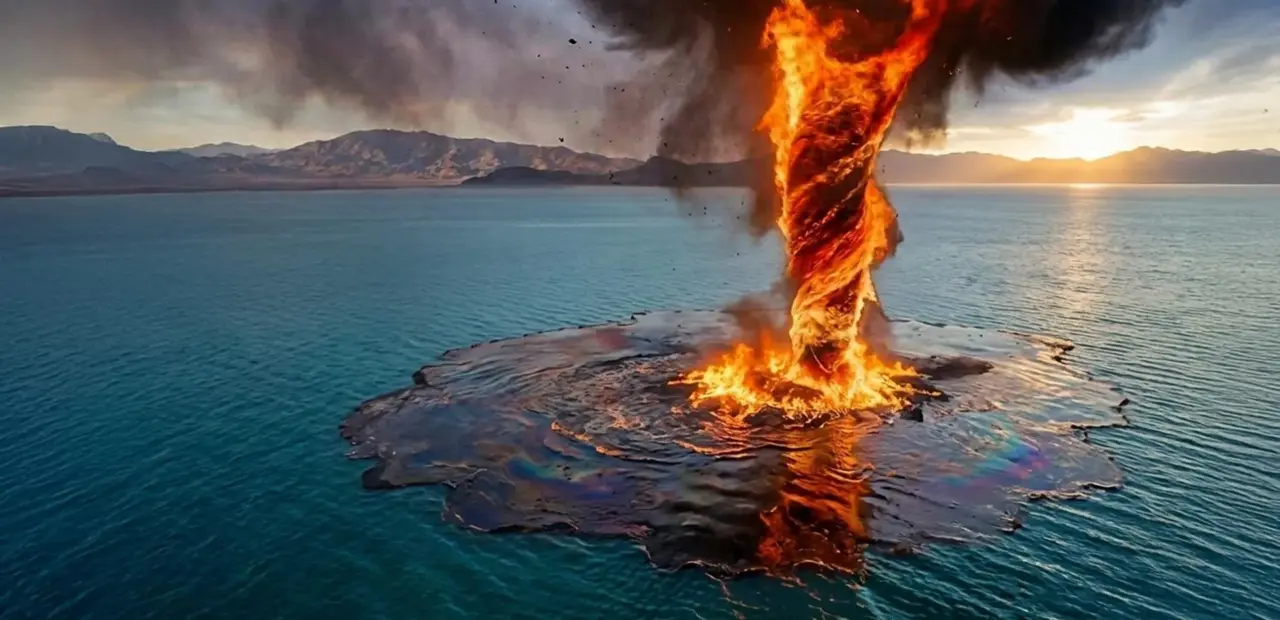
Researchers at Texas A&M University, the University of California, Berkeley, and the Bureau of Safety and Environmental Enforcement have demonstrated that controlled fire whirls can clean up oil spills more efficiently than traditional burning methods. In a large-scale experiment, the team built a 16-foot-tall triangular structure at the Texas A&M Engineering Extension Service Brayton Fire Training Field and ignited a pool of crude oil floating on water. The resulting fire whirl reached nearly 17 feet in height. The study, published in the journal Fuel, found that the spinning flames consumed up to 95% of the oil, cut soot emissions by 40%, and burned the oil about 40% faster compared to conventional in-situ fire tests. The researchers noted that fire whirls are sensitive to conditions such as wind and oil layer thickness, describing a narrow “Goldilocks” zone for optimal efficiency. The team envisions future portable systems that could generate fire whirls on demand for emergency oil spill response.
What’s reported
The study was supported by the Bureau of Safety and Environmental Enforcement (BSEE) and led by Dr. Elaine Oran and Dr. Qingsheng Wang of Texas A&M University and Dr. Michael Gollner of the University of California, Berkeley.
The experiment used a 16-foot-tall triangular structure with three walls to control airflow, with a 1.5-meter-wide pool of crude oil floating on water at the center.
The fire whirl reached nearly 17 feet in height.
Results published in the journal Fuel showed fire whirls burned oil about 40% faster, cut soot emissions by 40%, and achieved up to 95% fuel consumption efficiency compared to in-situ fire tests.
The researchers described a “Goldilocks” zone of ideal conditions; strong winds can destabilize the whirl, and oil layers that are too deep can extinguish the fire before all fuel is consumed.
The team envisions portable systems that could be deployed over burning oil spills to generate fire whirls on demand.
Key figures
Dr. Elaine Oran, professor of aerospace engineering, Texas A&M University
Dr. Qingsheng Wang, Texas A&M University
Dr. Michael Gollner, University of California, Berkeley
Bureau of Safety and Environmental Enforcement (BSEE)
Sources: ScienceDaily