



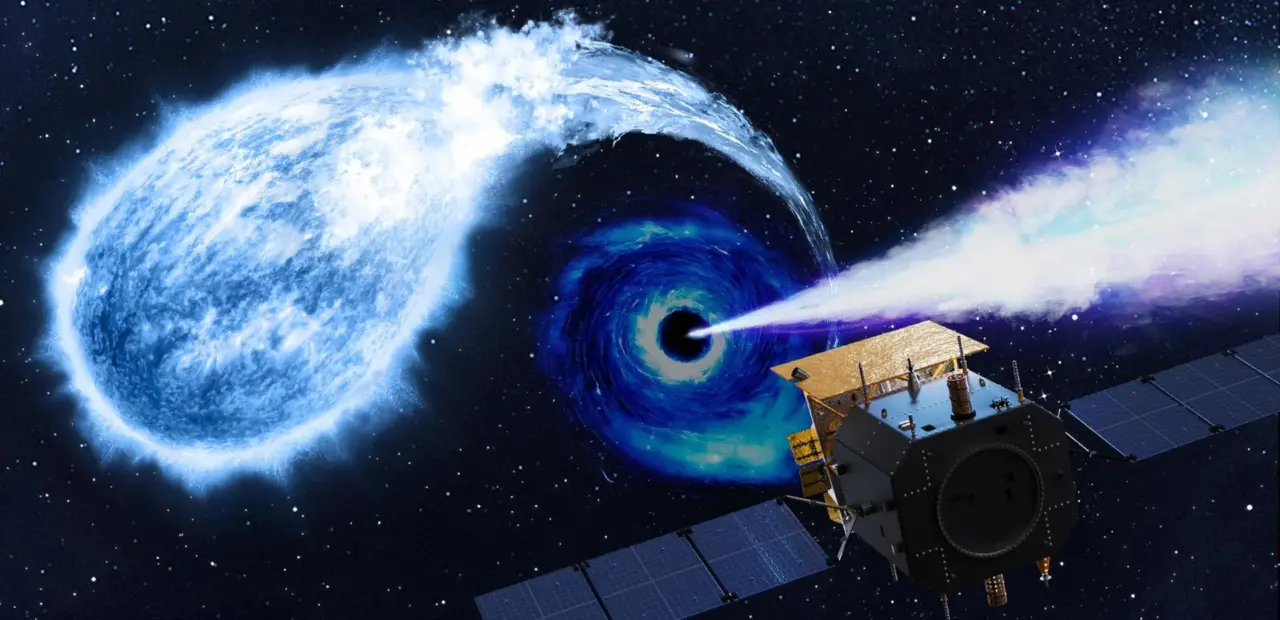
Einstein Probe may have observed black hole consuming white dwarf

8 reported
Astronomers may have witnessed an intermediate-mass black hole tearing apart and consuming a white dwarf star, an event detected by the China-led Einstein Probe space telescope. On July 2, 2025, the telescope’s Wide-field X-ray Telescope spotted a rapidly changing X-ray source during a routine survey. The source, designated EP250702a, was also detected by NASA’s Fermi Gamma-ray Space Telescope. Researchers from the National Astronomical Observatories, Chinese Academy of Sciences, and the University of Hong Kong analyzed the observations. Their analysis suggests the event may represent a rare black hole feeding event, which would be the first direct observational evidence of its kind. The results were published as the cover article in Science Bulletin.
What’s reported
The Einstein Probe detected an X-ray source on July 2, 2025, during a routine survey.
The source was designated EP250702a and also detected by NASA’s Fermi Gamma-ray Space Telescope.
The Wide-field X-ray Telescope had detected steady X-ray emission from the same location roughly a day before gamma-ray bursts appeared.
Around 15 hours after initial detection, the source erupted into intense X-ray flares, reaching a luminosity of approximately 3 × 10^49 erg s^-1.
Over roughly 20 days, the object’s brightness faded by more than a factor of 100,000, and its X-ray emission shifted from hard to soft X-rays.
The event occurred on the outskirts of a distant galaxy, not near its center.
The strongest candidate explanation is an intermediate-mass black hole tearing apart and consuming a white dwarf star.
The research was coordinated by the EP Science Center at NAOC, with contributions from HKU and other institutions.
Key figures
Dr. Dongyue Li, first author of the paper from the National Astronomical Observatories of China.
Researchers from the Department of Physics at The University of Hong Kong (HKU).
Sources: ScienceDaily