



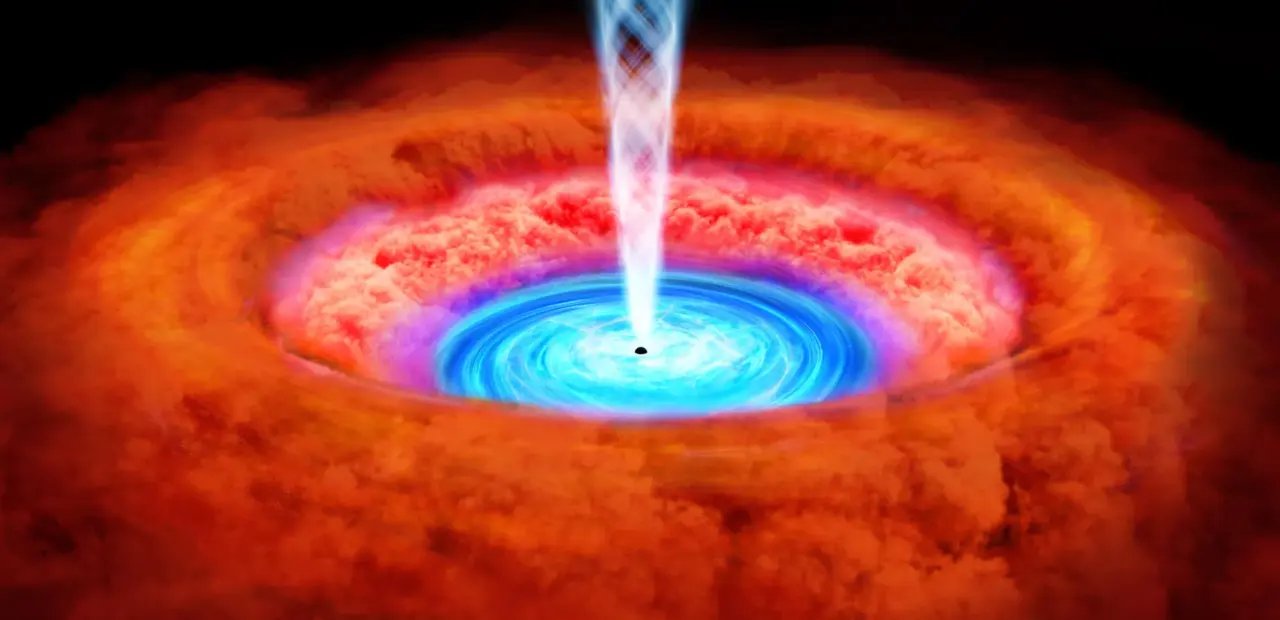
Black hole winds may be robbing giant galaxies of their future stars

6 reported
Astronomers may be getting closer to solving a long-standing mystery about why some of the universe’s largest galaxies have far fewer stars than expected. Using observations from the X-Ray Imaging and Spectroscopy Mission (XRISM), a University of Michigan doctoral student has found evidence that supermassive black holes can unleash powerful winds that blow away the raw material needed to make new stars. The research focused on NGC 4151, a bright galaxy located a little more than 50 million light-years from Earth. XRISM, launched in 2023 and beginning scientific observations in fall 2024, has roughly 10 times better energy resolution than its predecessor. The student, Xin “Cindy” Xiang, presented a new method for determining when the galaxy’s powerful winds are active at the 248th meeting of the American Astronomical Society. Her analysis revealed that the strongest fast winds appeared when X-rays were hard but relatively faint, typically about 10,000 seconds after X-ray flares. This finding provides the first direct timing connection between X-ray activity and the winds flowing from the black hole’s accretion disk.
What’s reported
The mystery is why some of the universe’s biggest galaxies seem to have far fewer stars than expected.
XRISM is led by the Japanese Aerospace Exploration Agency in partnership with NASA and the European Space Agency.
NGC 4151 is located a little more than 50 million light-years from Earth.
Xiang analyzed hundreds of days of XRISM observations of NGC 4151.
The fastest outflows appeared about 10,000 seconds (just under three hours) after X-ray flares.
Xiang created a new metric called the color intensity index, shortened to “cindicity.”
Key figures
Xin “Cindy” Xiang, University of Michigan doctoral student
Jon Miller, University of Michigan astronomy professor
Sources: ScienceDaily