



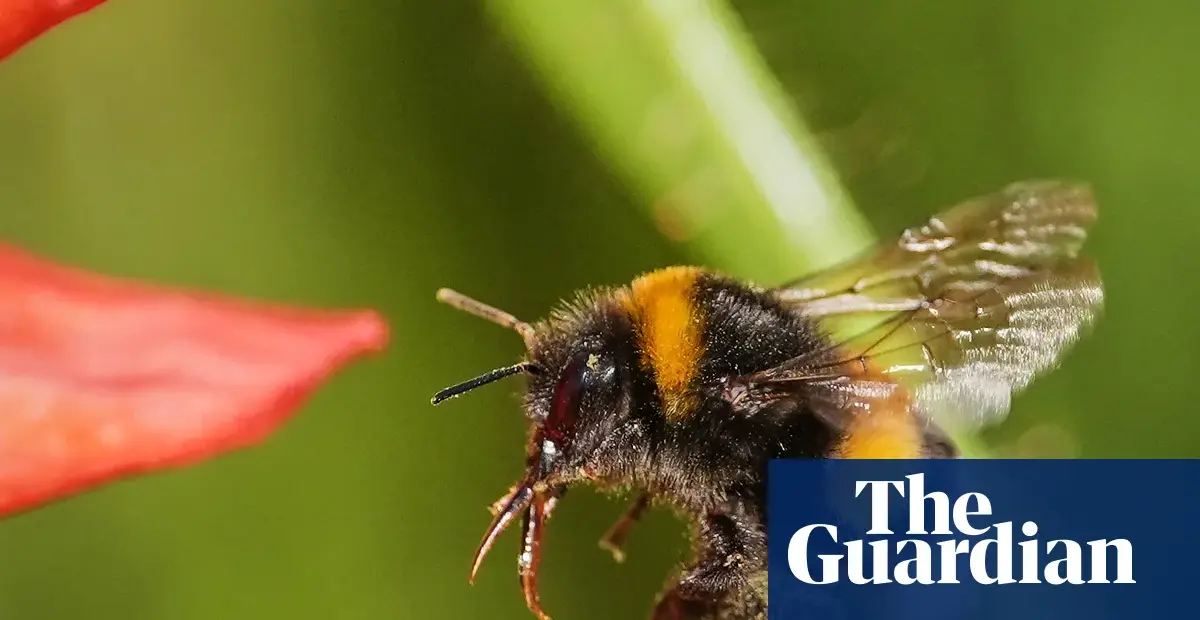
Bumblebees demonstrate tool use to solve problems, study finds

7 reported
A new study published in the journal Science reports that bumblebees can use tools to solve a problem, challenging assumptions that insects operate purely on instinct. Researchers presented bees with an adapted version of a classic experiment first used with chimpanzees 100 years ago, involving stacking boxes to reach a banana. In the bee version, the insects had to roll a polystyrene ball to a specific location and climb onto it to access an artificial flower on a low ceiling. The bees, only a couple of weeks old, were first trained to associate a blue artificial flower with a sugar water reward. During the test, the flower was moved to the ceiling of a transparent chamber too high for the bees to reach, with insufficient space to hover. A ball was introduced, and the bees had to roll it under the flower and climb on top, a behavioral sequence they had never encountered or been trained to perform. In the most basic version, 75% of the bees were successful. In a more complex version testing memory, 23 out of 30 bees succeeded after the flower was hidden under red light.
What’s reported
The study was published in the journal Science.
Bumblebees were given an adapted version of an experiment that 100 years ago first demonstrated chimpanzees could retrieve an out-of-reach banana by stacking boxes.
The bees had to roll a polystyrene ball to a specific location and climb onto it to access an artificial flower on a low ceiling.
The bees were only a couple of weeks old and were first trained to associate a blue artificial flower with a reward of sugar water.
During the test, the flower was moved to the ceiling of a transparent petri dish-style chamber whose ceiling was too high for them to reach, with insufficient space to hover.
In the most basic version of the test, 75% of the bees were successful.
In a final setup, bees needed to recall the location of the flower and position the ball beneath it under red light; 23 out of 30 bees were successful.
Misconceptions
The article addresses the misconception that insects operate purely on instinct and mindless trial-and-error learning, and that intelligent behavior requires big brains.
Key figures
Dr Olli Loukola, behavioral ecologist at the University of Oulu, Finland, and senior author of the study.
Prof Lars Chittka, behavioral ecologist at Queen Mary University of London, author of The Mind of a Bee, not involved in the latest research.
Sources: The Guardian