


Jupiter lightning may be 100 times more powerful than Earth’s, study finds

The Story
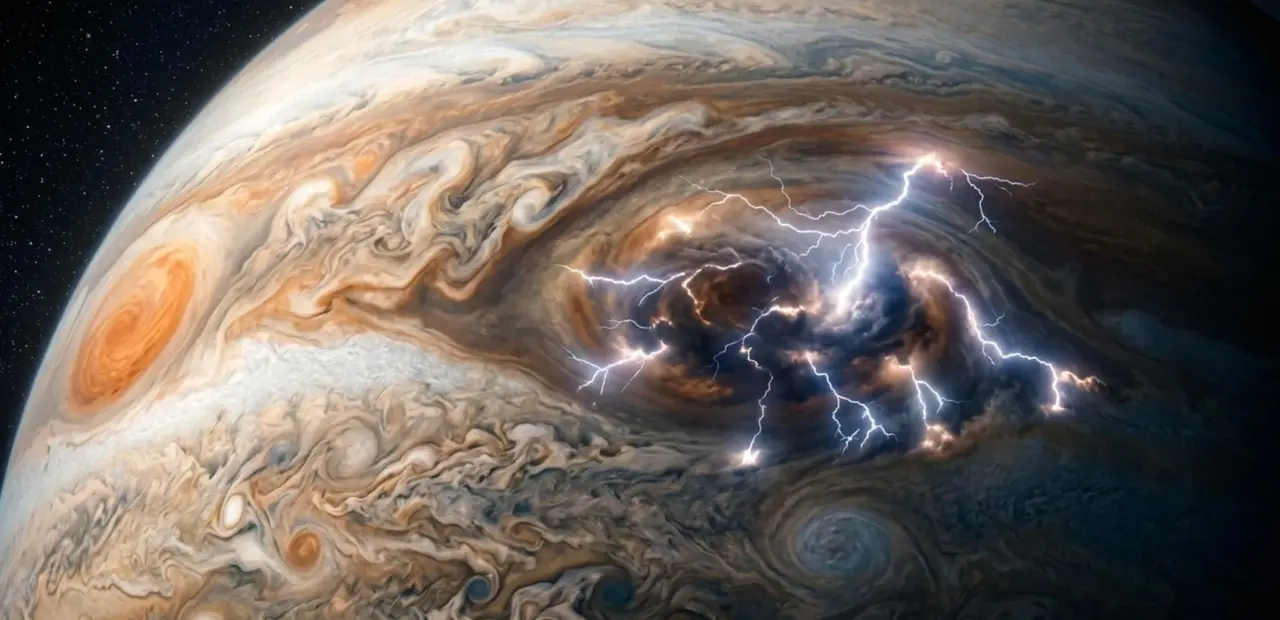
A study using data from NASA’s Juno spacecraft indicates that some lightning flashes on Jupiter may be 100 times stronger than lightning on Earth, and possibly even more intense. Researchers at the University of California, Berkeley, analyzed microwave signals from the planet’s storms and published their findings in the journal AGU Advances. The study focused on “stealth” superstorms observed in Jupiter’s North Equatorial Belt during a period of reduced storm activity in 2021 and 2022.
Key Facts
- The research was led by Michael Wong, a planetary scientist at UC Berkeley’s Space Sciences Laboratory.
- Juno’s microwave radiometer detected radio emissions from lightning; the instrument was not specifically designed to study lightning.
- During 12 flyovers over isolated storms, Juno made four passes close enough to measure microwave signals.
- Scientists recorded an average of three lightning flashes per second during those passes. In one encounter, Juno detected 206 separate microwave pulses.
- Out of 613 measured pulses, the team estimated lightning ranged from roughly Earth-strength to more than 100 times stronger.
- Co-author Ivana Kolmašová, a space physicist at Charles University in Prague, said determining total energy is complicated because lightning releases energy across multiple forms.
- Wong estimated Jupiter lightning may release anywhere from 500 to possibly 10,000 times more energy than Earth lightning.
- Jupiter’s storms can rise more than 100 kilometers high, compared to roughly 10 kilometers for storms on Earth.
- The study was supported by NASA (grants 80NSSC19K1265, 80NSSC25K0362).
Conflicting Reports
No conflicting reports identified in the source article.
Still Unclear
Why Jupiter’s lightning can become so powerful remains an open question; researchers are investigating whether differences in atmospheric composition, storm height, or heat buildup are responsible.
Misconceptions
No widespread misconceptions addressed in the source article.
Key Figures
- Michael Wong – planetary scientist, UC Berkeley Space Sciences Laboratory (lead author)
- Ivana Kolmašová – space physicist, Charles University in Prague, Czechia (co-author)
- Ramanakumar Sankar – postdoctoral fellow, UC Berkeley (co-author)
- Fabiano A. Oyafuso, Masafumi Imai, Shinji Mizumoto, Steven M. Levin, Amy A. Simon, Shawn Brueshaber, Glenn S. Orton, Sushil K. Atreya, Cheng Li, Scott J. Bolton – co-authors from the United States, Czechia, and Japan
- NASA – provided support for the research
Sources: ScienceDaily