



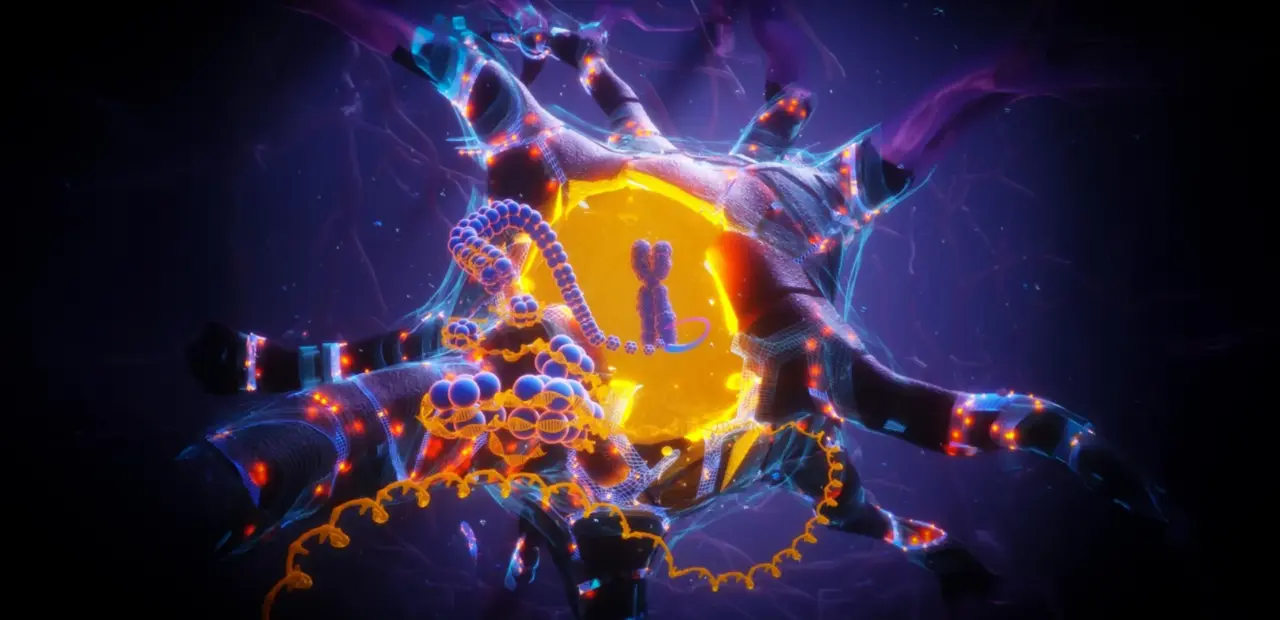
APOE2 gene may protect brain cells from DNA damage and aging, study finds

7 reported2 unconfirmed
A new study from the Buck Institute for Research on Aging, published in Aging Cell, suggests that the APOE2 form of the apolipoprotein E gene helps neurons protect their DNA and resist cellular senescence, a damaged cellular state linked to neurodegeneration. Researchers used human stem cell-derived neurons and older mice engineered with human APOE variants to compare the effects of APOE2, APOE3, and APOE4. They found that APOE2 neurons accumulated less DNA damage and showed stronger activation of DNA repair pathways, while APOE4 neurons displayed gene activity patterns associated with Alzheimer’s disease. The study also found that adding recombinant APOE2 protein to APOE4 neurons reduced DNA damage signaling after radiation exposure, indicating the protective effect may be transferable. The findings connect a major longevity gene to DNA repair and cellular aging, potentially opening new therapeutic directions for Alzheimer’s prevention.
What’s reported
The study was conducted by the Buck Institute for Research on Aging and published in Aging Cell.
APOE2 neurons accumulated less DNA damage than APOE3 or APOE4 neurons.
APOE2 GABAergic neurons activated DNA repair and damage response pathways, while APOE4 neurons showed Alzheimer’s-associated gene activity.
APOE2 neurons exposed to radiation or doxorubicin had lower levels of senescence markers (p16 and CRYAB) than APOE3 or APOE4 neurons.
Adding recombinant APOE2 protein to APOE4 neurons reduced DNA damage signaling after radiation.
Older APOE2 knock-in mice had smaller nucleoli, higher Lamin A/C levels, and better-preserved heterochromatin in the hippocampus compared to APOE3 or APOE4 mice.
The study was supported by the National Institute on Aging, the Paul F. Glenn Center for Biology of Aging, the Hevolution Foundation, and a CatalystX award.
Open questions
The exact mechanism by which APOE2 stabilizes the nuclear envelope and strengthens DNA repair is not yet known.
Whether APOE2-mimetic compounds or targeted DNA repair treatments can provide similar protection in people with APOE4 remains to be tested.
Key figures
Lisa M. Ellerby, PhD, senior author and professor at the Buck Institute
Cristian Gerónimo-Olvera, PhD, co-first author and postdoctoral fellow at the Buck Institute
Other collaborators listed include Stephen M. Scheeler, Carlos Galicia Aguirre, Genesis Vega-Hormazabal, Daniela Garcia, Long Wu, Natalia Murad, Kevin Schneide, Kenneth A. Wilson, Nikola T. Markov, Jesse Simons, Akos A. Gerencser, Emily Parlan, Eric Verdin, Judith Campisi, Tara E. Tracy, David Furman, Simon Melov (Buck Institute); Sicheng Song and Sean D. Mooney (University of Washington)
Sources: ScienceDaily