



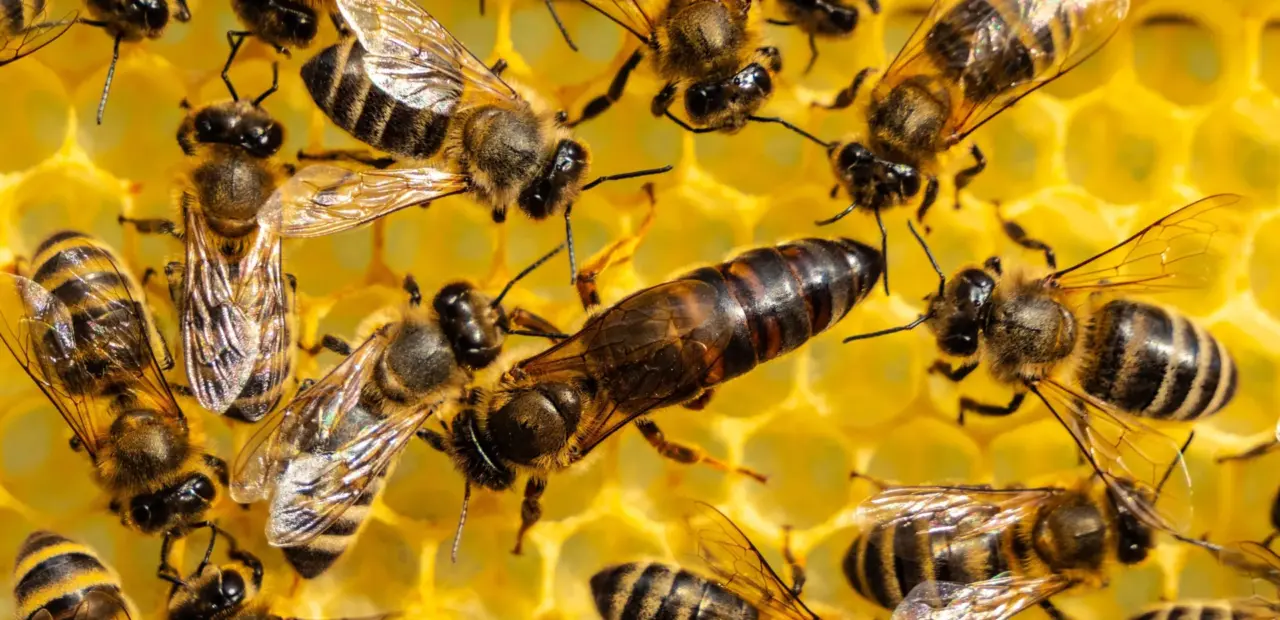
Study reveals queen bees are made by more than royal jelly

7 reported
A new study published in Nature on June 24, 2026, from the University of California, Riverside, reports that the process of creating a queen honeybee is more complex than previously believed. Researchers found that future queens are raised inside specially designed nursery chambers built by young worker bees, which provide unique wax, warmer conditions, and dedicated care. The study identified a previously unknown group of young worker bees called "queen cell builders" that appear specially suited for creating and maintaining these chambers. Using thermal imaging, behavioral monitoring, materials science, and chemical analysis, the team found that queen cells differ physically and chemically from ordinary hive wax, being less dense, more flexible, and better at retaining heat and moisture. Experiments showed that larvae raised in worker wax were more likely to die and developed into smaller queens, even when both groups received the same food. The researchers observed the same pattern in both Asian and European honeybee species, suggesting this strategy evolved long ago. The project was led by former UCR postdoctoral researchers Yu Fang and Yahya Al Naggar.
What’s reported
The study was published in Nature on June 24, 2026, by researchers at the University of California, Riverside.
Queen cells are built from wax that is less dense, more flexible, and better at retaining heat and moisture than ordinary hive wax.
A previously unknown group of young worker bees called "queen cell builders" creates and maintains these chambers.
Larvae raised in worker wax were more likely to die and developed into smaller queens, even when fed the same food as those in queen wax.
The same pattern was observed in both Asian and European honeybee species.
Queen bees reach maturity in about 16 days, while worker bees require roughly 21 days.
The project was led by former UCR postdoctoral researchers Yu Fang and Yahya Al Naggar.
Key figures
Boris Baer, entomologist and director of the Center for Integrative Bee Research (CIBER) at the University of California, Riverside
Yu Fang, former UCR postdoctoral researcher
Yahya Al Naggar, former UCR postdoctoral researcher
Sources: ScienceDaily