



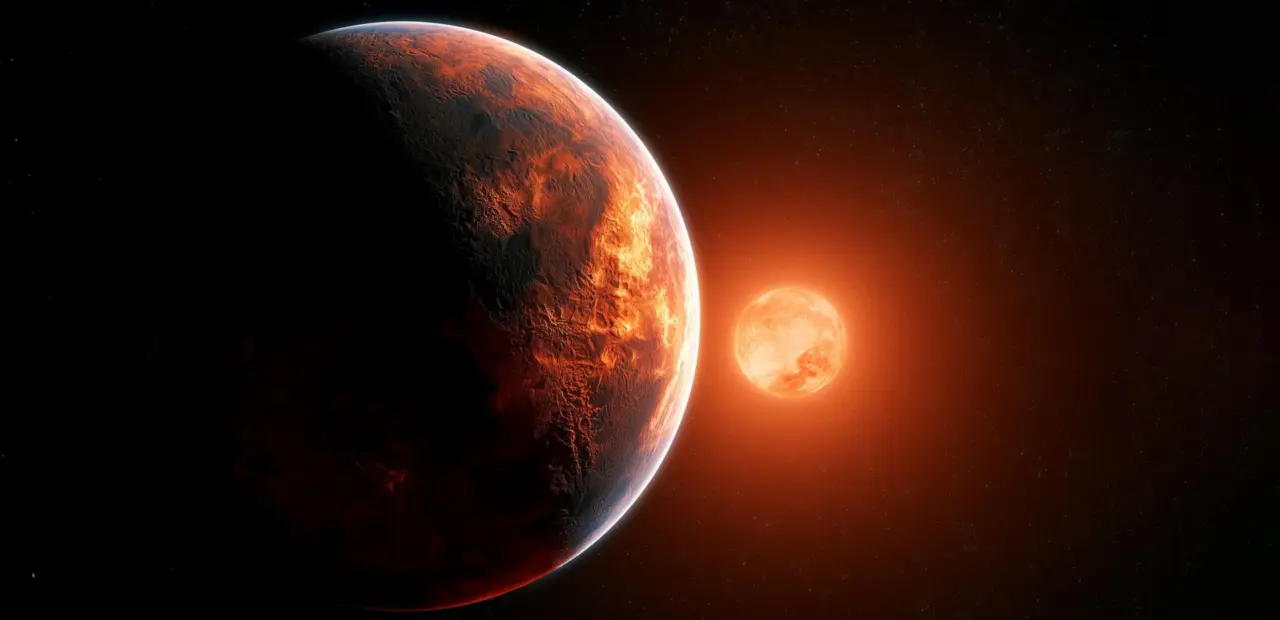
Tidally locked exoplanet may support life despite extreme temperatures

6 reported
A study published in Nature Communications suggests that tidally locked exoplanets, which have one side in permanent daylight and the other in endless night, may be more hospitable to life than previously thought. Researchers from the University of Pennsylvania, the Japan Agency for Marine-Earth Science and Technology, and Hokkaido University built a laboratory model to simulate the interior of such a planet. The model revealed a stable, continuous heat circulation loop within the mantle, which could moderate temperatures in certain regions. The study focused on the exoplanet LHS 3844b, a tidally locked world slightly larger than Earth located 48.5 light years away. Daytime temperatures on LHS 3844b can reach 1,000 to 2,000 Kelvin, while the night side approaches absolute zero. The researchers found that the steady circulation pattern may help maintain localized geothermal environments favorable for life, particularly in mid-latitude regions.
What’s reported
LHS 3844b is a tidally locked exoplanet slightly larger than Earth, orbiting the red dwarf star LHS 3884, 48.5 light years away.
Daytime temperatures on LHS 3844b reach roughly 1,000 to 2,000 Kelvin; the night side approaches absolute zero.
Researchers built a tabletop laboratory model using glycerol and thermochromic liquid crystals to mimic the planet's interior.
The experiment showed a stable, continuous heat circulation loop: hot material rose beneath the day side, flowed across the upper region, cooled at the night side, sank, and returned through the lower mantle.
Heat transport measurements (Nusselt numbers) were comparable to those of Earth's mantle.
The study was published in Nature Communications on July 9, 2026, by researchers from the University of Pennsylvania, the Japan Agency for Marine-Earth Science and Technology, and Hokkaido University.
Key figures
Daisuke Noto, postdoctoral researcher in the School of Arts & Sciences at the University of Pennsylvania
Hugo Ulloa, assistant professor in the Department of Earth and Environmental Science at Penn Arts & Sciences
Takehiro Miyagoshi and Takatoshi Yanagisawa of the Japan Agency for Marine-Earth Science and Technology
Tomomi Terada and Yuji Tasaka of Hokkaido University
Sources: ScienceDaily