



SETI study suggests alien signals may be hidden by stellar activity

8 reported
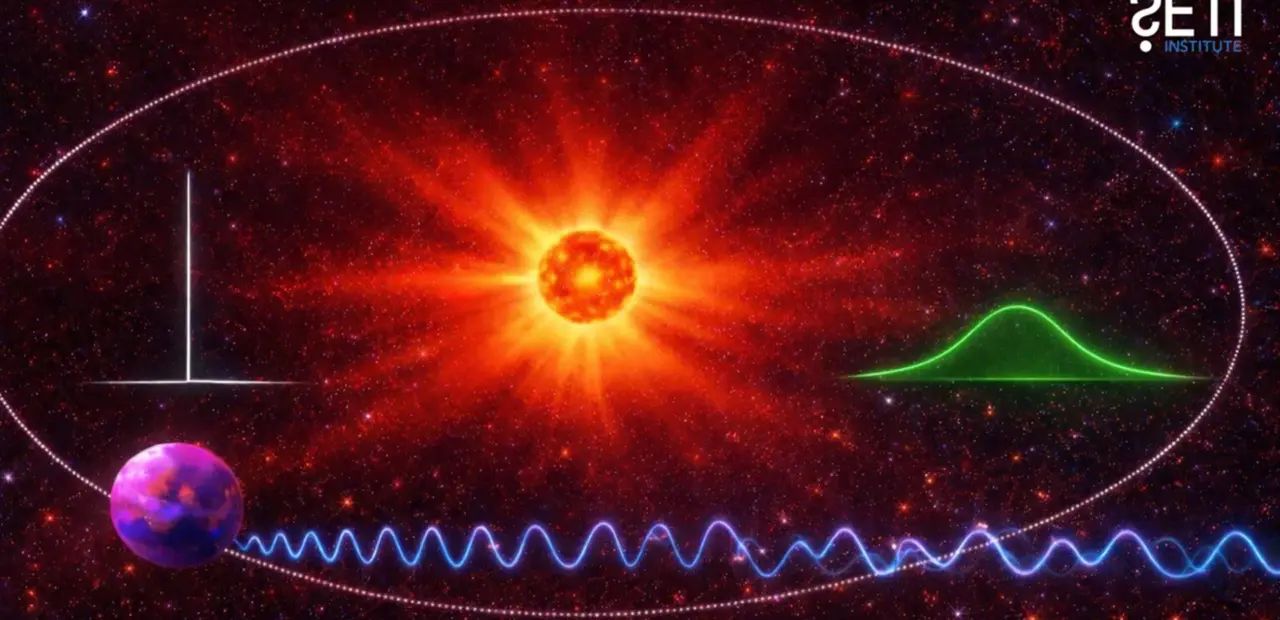
A new study from the SETI Institute proposes that extraterrestrial radio signals may be reaching Earth but going undetected because they are distorted by the activity of their own stars before leaving their home star system. Researchers found that fluctuations in plasma density within stellar winds and events such as coronal mass ejections can spread a narrow radio signal across a wider range of frequencies, weakening the sharp peak that traditional SETI searches depend on. The study used observations from spacecraft within our solar system to calibrate how turbulent plasma affects narrowband radio signals, then applied those measurements to estimate signal broadening around other stars. The effect is expected to be especially significant around M-dwarf stars, which make up roughly 75% of all stars in the Milky Way. The findings suggest that future searches should remain sensitive to signals wider than the ultra-narrow signatures traditionally targeted. The research was supported by the SETI Institute’s STRIDE program, funded through the Franklin Antonio Bequest.
What’s reported
A new SETI Institute study suggests alien signals may be scrambled by their own stars before escaping into space.
Turbulent plasma and stellar storms can spread an ultra-narrow radio transmission across a wider range of frequencies.
The effect could be especially important around M-dwarf stars, the most common stars in the Milky Way.
Researchers used observations from solar system probes to calibrate how turbulent plasma affects narrowband radio signals.
The study provides a framework to estimate signal broadening around different types of stars and at different observing frequencies.
Lead author Dr. Vishal Gajjar stated that if a signal gets broadened by its own star’s environment, it can slip below detection thresholds.
Co-author Grayce C. Brown said the work helps design searches matched to what actually arrives at Earth.
The research was supported by the SETI Institute’s STRIDE program, funded through the Franklin Antonio Bequest.
Key figures
Dr. Vishal Gajjar, Astronomer at the SETI Institute and lead author of the paper
Grayce C. Brown, co-author of the study and research assistant at the SETI Institute
Sources: ScienceDaily