



Quantum proton shuttle boosts triplet energy transfer, study finds

10 reported
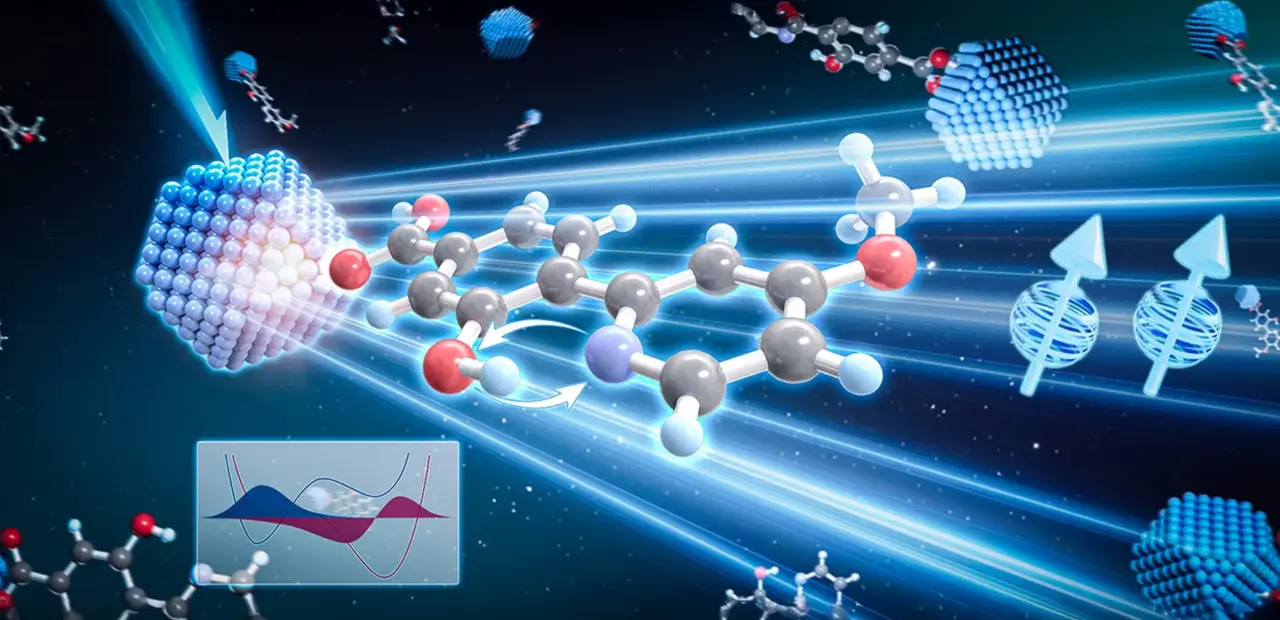
Researchers at the Dalian Institute of Chemical Physics of the Chinese Academy of Sciences have discovered a mechanism called proton shuttle-assisted triplet energy transfer (PS-TET) that significantly improves how triplet energy moves between quantum dots and nearby molecules. In a study published in Nature Materials, the team observed the process as energy transferred from ZnSe-based colloidal quantum dots to phenol-pyridine dyadic acceptors attached to their surfaces. The mechanism involves a proton briefly shifting position to help coordinate electron movement before returning to its original location. The researchers found that the proton shuttle greatly increases both the speed and efficiency of triplet energy transfer compared with a methylated analog lacking the shuttle. The rate of PS-TET changed very little with temperature, suggesting the proton moves through quantum mechanical tunneling rather than a conventional heat-driven process. The findings indicate that quantum effects can be used to control charge and energy transfer in complex materials even at room temperature.
What’s reported
The study was led by Prof. Kaifeng Wu at the Dalian Institute of Chemical Physics, Chinese Academy of Sciences.
The mechanism is called proton shuttle-assisted triplet energy transfer (PS-TET).
The process was observed as energy moved from ZnSe-based colloidal quantum dots to phenol-pyridine dyadic acceptors.
When ZnSe QDs absorb light, a hole moves from ZnSe to phenol while a proton shifts from phenol to pyridine.
An electron then transfers from ZnSe to the phenoxyl radical, and the proton moves back from pyridinium to its original location.
The proton shuttle increases both the speed and efficiency of triplet energy transfer compared with a methylated analog without the shuttle.
Adding a trifluoromethyl substituent to pyridine can change the order of proton-coupled electron and hole transfer steps.
The rate of PS-TET changed very little with temperature, indicating quantum mechanical tunneling.
Calculations involving proton vibrational wavefunction overlap integrals supported the tunneling interpretation.
The study was published in Nature Materials on July 22, 2026.
Key figures
Prof. Kaifeng Wu, researcher at the Dalian Institute of Chemical Physics, Chinese Academy of Sciences
Zhaolong Wang, co-author of the study
Jingyi Zhu, co-author of the study
Sources: ScienceDaily