



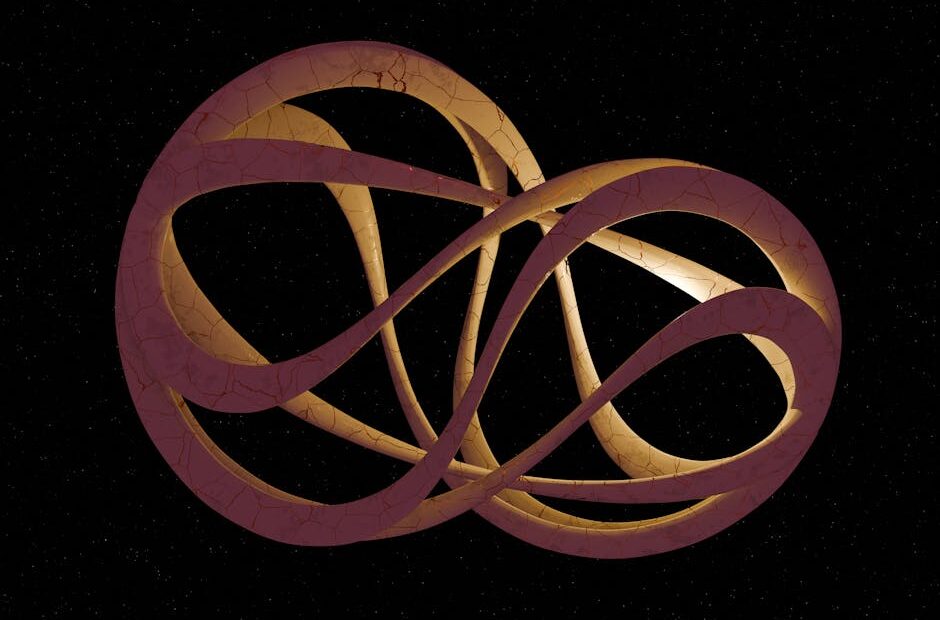
Einstein-Rosen bridge reinterpreted as time mirror, not wormhole

The Story
New research reinterprets the Einstein-Rosen “bridge” as a connection between two opposite arrows of time rather than a traversable wormhole. The study, based on a modern quantum view of time, suggests the bridge may solve the black hole information paradox and allow for a universe that existed before the Big Bang.
Key Facts
- Einstein and Rosen in 1935 introduced a “bridge” as a mathematical link between two symmetrical copies of spacetime, not as a travel passage.
- The new research, led by Enrique Gaztanaga, interprets the bridge as a mirror in spacetime connecting two microscopic arrows of time — one flowing forward, one backward.
- Under this interpretation, information does not vanish at a black hole’s event horizon but continues evolving along the opposite temporal direction, offering a resolution to the black hole information paradox.
- The cosmic microwave background shows a small asymmetry that standard models assign low probability — but mirror quantum components could explain it.
- The Big Bang may not have been an absolute beginning but a bounce between two time-reversed phases of cosmic evolution.
- Relics from a pre‑bounce phase, such as smaller black holes, could appear in our universe and account for some unseen dark matter.
- The study was published in Classical and Quantum Gravity (2026, volume 43, article 015023).
Conflicting Reports
No conflicting reports identified in the source article.
Still Unclear
The article does not specify whether observational evidence for the pre‑bounce relics currently exists, nor how to test the proposed time‑mirror framework beyond the cosmic microwave background asymmetry.
Misconceptions
The source article directly addresses the common misconception that Einstein–Rosen bridges are wormholes for travel, noting that within general relativity such a journey is forbidden and the bridges are non‑traversable.
Key Figures
- Enrique Gaztanaga – Professor of Astrophysics at the Institute of Cosmology and Gravitation, University of Portsmouth, and author of the original article
- Sravan Kumar – co‑author of the journal study
- João Marto – co‑author of the journal study
- Albert Einstein and Nathan Rosen – physicists who introduced the “bridge” in 1935
- Stephen Hawking – described black hole evaporation in 1974, leading to the information paradox
Sources: ScienceDaily