



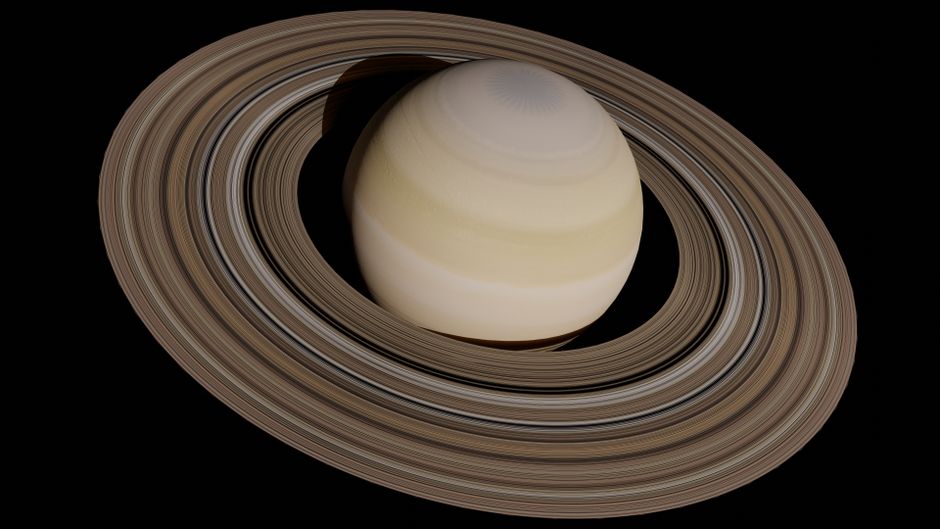
Astronomers solve Saturn’s rotation mystery with Webb Telescope data

The Story
Researchers using the James Webb Space Telescope have solved a decades-old mystery about Saturn’s changing rotation rate. According to a study published in the Journal of Geophysical Research: Space Physics, the planet never actually sped up or slowed down. Instead, powerful winds in Saturn’s upper atmosphere, driven by its aurora, altered the electrical signals scientists used to measure rotation. The team observed Saturn’s northern auroral region continuously for one Saturnian day, creating detailed temperature maps with ten times greater precision than previous instruments. The data matched computer models showing that auroral heating creates winds that generate electrical currents, which in turn power the aurora in a self-sustaining cycle. Lead researcher Professor Tom Stallard described the process as a “planetary heat pump” that feeds itself. The findings, from Northumbria University and partners, close a gap in understanding why the atmospheric winds existed. The study also suggests similar interactions may occur on other planets.
Key Facts
- Saturn’s apparent rotation rate was thought to be changing, but the planet never actually sped up or slowed down.
- The James Webb Space Telescope observed Saturn’s northern aurora for an entire Saturnian day.
- JWST measurements were about ten times more precise than earlier observations, with uncertainties of roughly 50 degrees Celsius reduced significantly.
- The aurora heats Saturn’s upper atmosphere, driving winds that create electrical currents, which then power the aurora again.
- Computer models predicted this self-sustaining cycle more than a decade ago; JWST data matched the models exactly.
- The study was published in the Journal of Geophysical Research: Space Physics on May 29, 2026.
- Research was led by Northumbria University with collaborators from Boston University, University of Leicester, Aberystwyth University, University of Reading, Imperial College London, Lancaster University, and Johns Hopkins University Applied Physics Laboratory.
- Funding came from the Science and Technology Facilities Council (STFC).
Conflicting Reports
No conflicting reports identified in the source article.
Still Unclear
No open questions identified in the source article.
Misconceptions
No widespread misconceptions addressed in the source article.
Key Figures
- Professor Tom Stallard, Northumbria University, lead researcher
Sources: ScienceDaily