



Alternative battery technologies aim to store renewable energy using diverse materials

8 reported
A Guardian report examines several emerging battery technologies that could store renewable energy without relying on critical minerals like lithium, cobalt, and nickel. In the United Arab Emirates, a project combining 5.2GW of solar power with 19GWh of battery storage is described as the largest battery scheme in the world. Meanwhile, researchers at the US National Renewable Energy Laboratory in Colorado are developing tiny batteries to track young salmon and eels. The article highlights five alternative storage methods: liquid air, molten salt, sand, sweat-based power, and traditional lithium-ion batteries. These technologies are being explored for applications ranging from grid-scale storage to wearable devices.
What’s reported
The UAE project combines 5.2GW of solar power with 19GWh of battery storage, covering an area roughly the size of 12,600 football fields.
US researchers are making tiny batteries to power electronic tags for 3-inch-long young salmon and eels.
Unlike lithium-ion batteries, many alternative batteries can be used indefinitely and recycled after a 20-year service life.
The Carrington liquid air project in Trafford, UK, aims to store energy as liquid air at -196C, delivering 300MWh of storage and 50MW output for six hours.
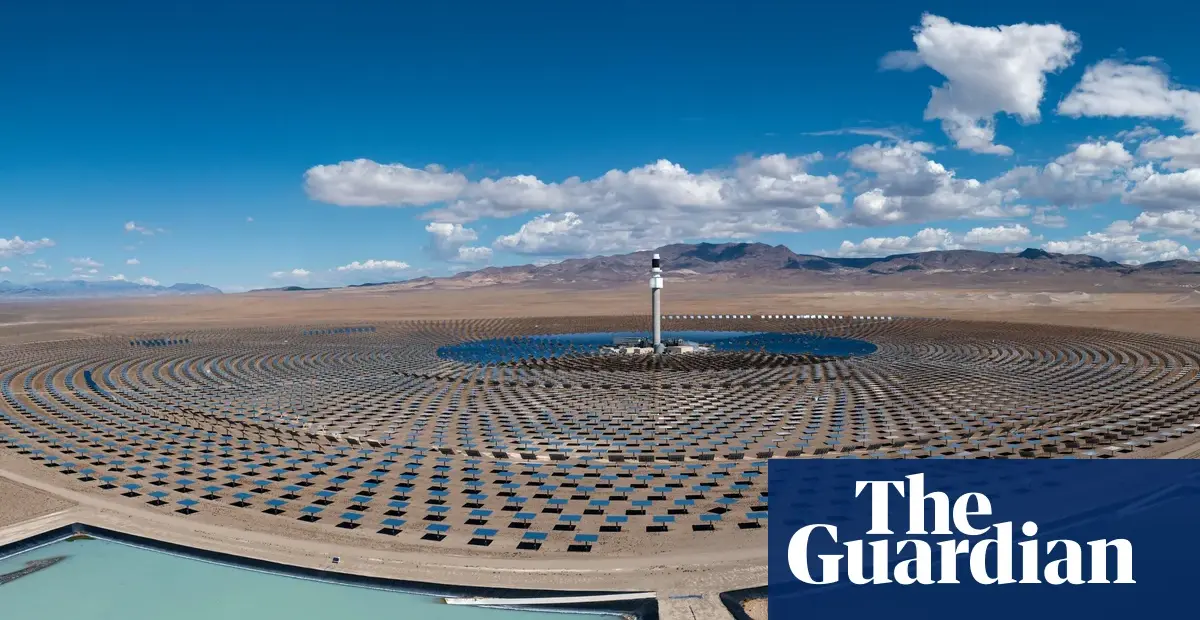
Crescent Dunes in Nevada uses 10,000 panes to heat potassium and sodium nitrate to 560C, maintaining temperature for 10 hours after sunset.
Denmark unveiled a 1GWh molten salt battery that can store clean electricity for up to two weeks by heating salts to approximately 600C.
A sand battery in Pornainen, Finland, uses 2,000 tonnes of crushed soapstone to provide 1MW of thermal power and 100MWh storage.
Japanese researchers at Tokyo University of Science developed a wearable patch that generates electricity from lactate in human sweat using an enzymatic biofuel cell.
Key figures
Andy Burnham, former mayor of Greater Manchester
Highview Power, British startup developing the Carrington project
Tokyo University of Science, researchers developing sweat-based power
Sources: The Guardian