



Physicists solve bird flock modeling problem with imaginary partners

6 reported
Physicists at Technische Universität Dresden have developed a new theory to model systems that appear to violate Newton’s third law, such as bird flocks and bacterial swarms. The third law, often summarized as “for every action, there is an equal and opposite reaction,” has been a foundation of classical physics for more than 300 years. In bird flocks, individuals only pay attention to birds beside or ahead of them, not behind, creating one-way interactions that traditional theories could not accurately simulate. The research team, working with physicist Roderich Moessner, introduced artificial “imaginary partners” to transform these non-reciprocal interactions into a form that can be analyzed using established methods. The approach allows scientists to simulate complex systems with unprecedented accuracy and apply existing many-body physics tools. The findings were published in the journal Nature Physics.
What’s reported
The research was conducted by scientists at Technische Universität Dresden, working with physicist Roderich Moessner.
Moessner is a Principal Investigator of the Würzburg-Dresden Cluster of Excellence ctd.qmat and director of the Max Planck Institute for the Physics of Complex Systems in Dresden.
The team’s solution involves adding artificial variables called “auxiliary degrees of freedom” to models.
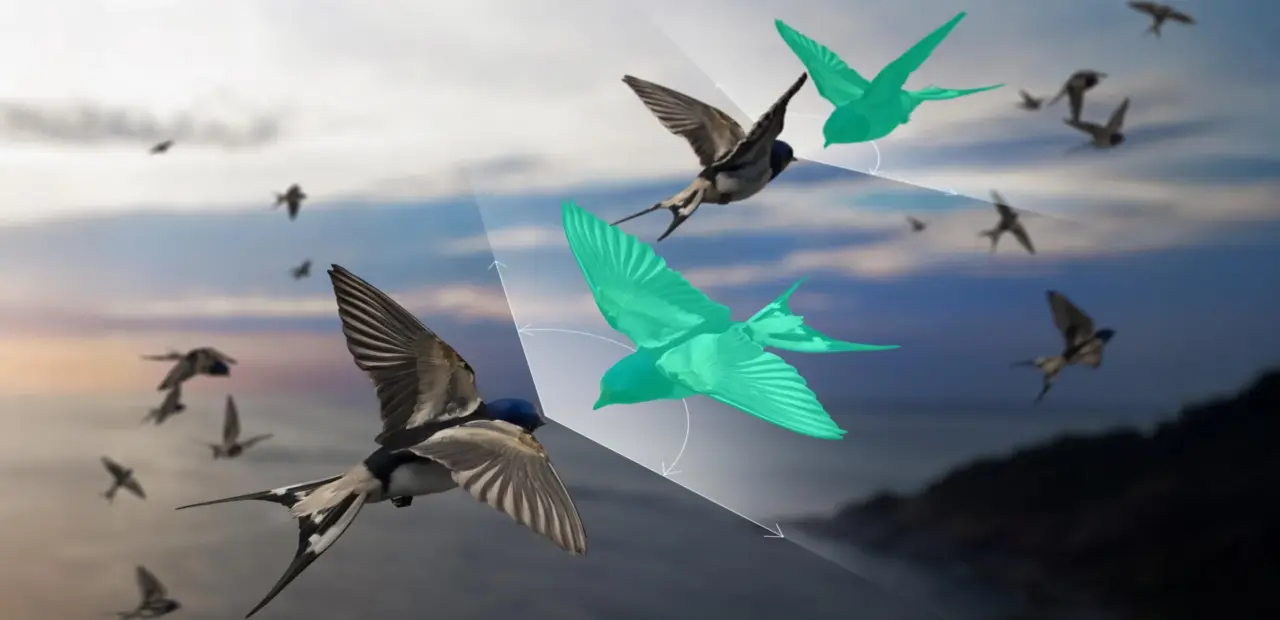
For bird flocks, this means placing a fictitious bird in front of each real bird, aligned in the opposite direction, as a mathematical tool.
The theory allows non-reciprocal systems to be described exactly and simulated precisely using established methods.
The study was published in the journal Nature Physics.
Key figures
Marín Bukov, research group leader at Technische Universität Dresden
Roderich Moessner, physicist and director at Max Planck Institute for the Physics of Complex Systems
Ricard Alert, biophysicist and colleague of Bukov
Sources: ScienceDaily