



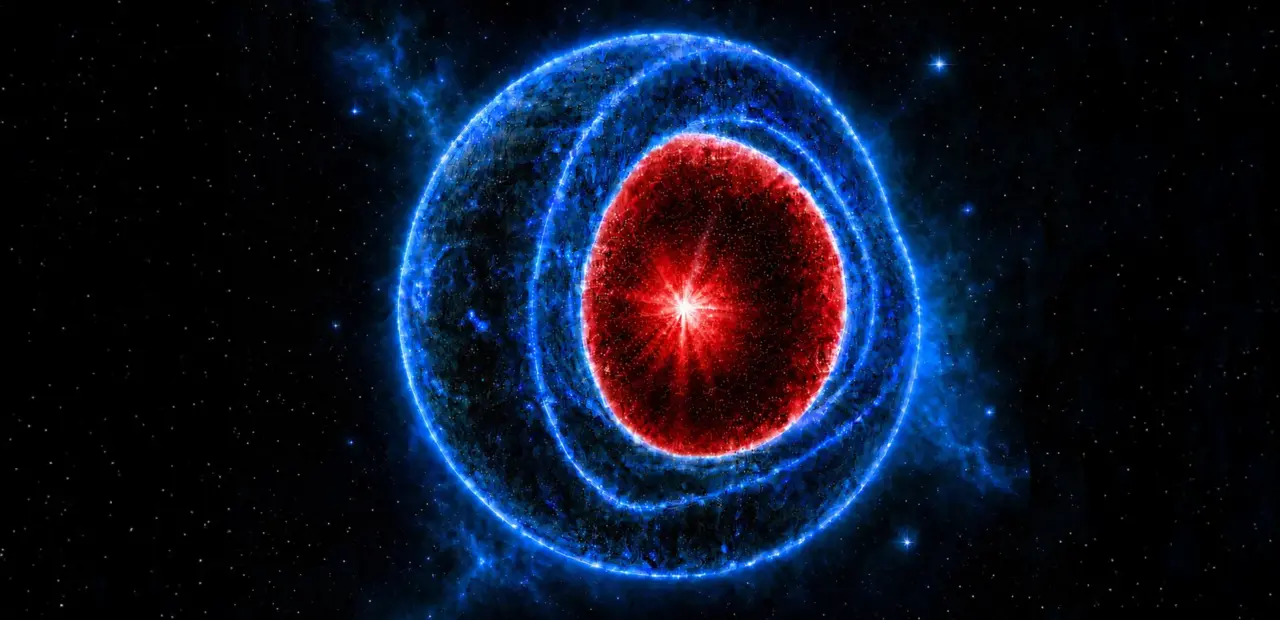
Study proposes dying star could create new universe instead of black hole

8 reported
A new theoretical study from Goethe University Frankfurt suggests that when a massive star collapses, it might not form a black hole but instead trigger the birth of a tiny new universe inside the dying star. The research, published in Physical Review D, proposes the first dynamic solution to Einstein’s equations of General Relativity explaining how a gravastar could form. Gravastars are ultra-compact objects filled with dark energy that produce an outward pressure counteracting gravity, avoiding the singularity and event horizon associated with black holes. The study’s authors, Daniel Jampolski and Professor Luciano Rezzolla, say the collapse of a massive star may cause a miniature universe to expand within the collapsing matter, halting collapse before a black hole forms. The researchers note that the Big Bang of this emerging universe could occur after the star has already collapsed almost to the point of becoming a black hole. Rezzolla emphasized that exploring alternatives does not mean rejecting black holes, which remain the most natural and simplest solution to gravitational collapse.
What’s reported
The study was conducted by theoretical physicists Daniel Jampolski and Professor Luciano Rezzolla at Goethe University Frankfurt.
It was published in Physical Review D on June 14, 2026.
The research proposes the first dynamic solution to Albert Einstein’s equations of General Relativity explaining how a gravastar could form.
A gravastar is an ultra-compact object filled with dark energy that produces outward pressure counteracting gravity.
Unlike black holes, gravastars would not contain a singularity or an event horizon.
The collapse of a massive star may trigger the birth of a miniature universe within the collapsing matter, driven by dark energy.
This mini universe expands and pushes outward against gravity, halting collapse before a black hole forms.
The researchers say this provides the first explanation for how gravastars could emerge from the collapse of ordinary matter, a question debated for roughly 25 years.
Key figures
Daniel Jampolski, theoretical physicist, developed the solution during his master’s thesis under the supervision of Luciano Rezzolla.
Professor Luciano Rezzolla, Professor of Theoretical Astrophysics at Goethe University Frankfurt.
Sources: ScienceDaily