


Octopuses learn to use mirrors to find hidden food, study finds

7 reported1 unconfirmed
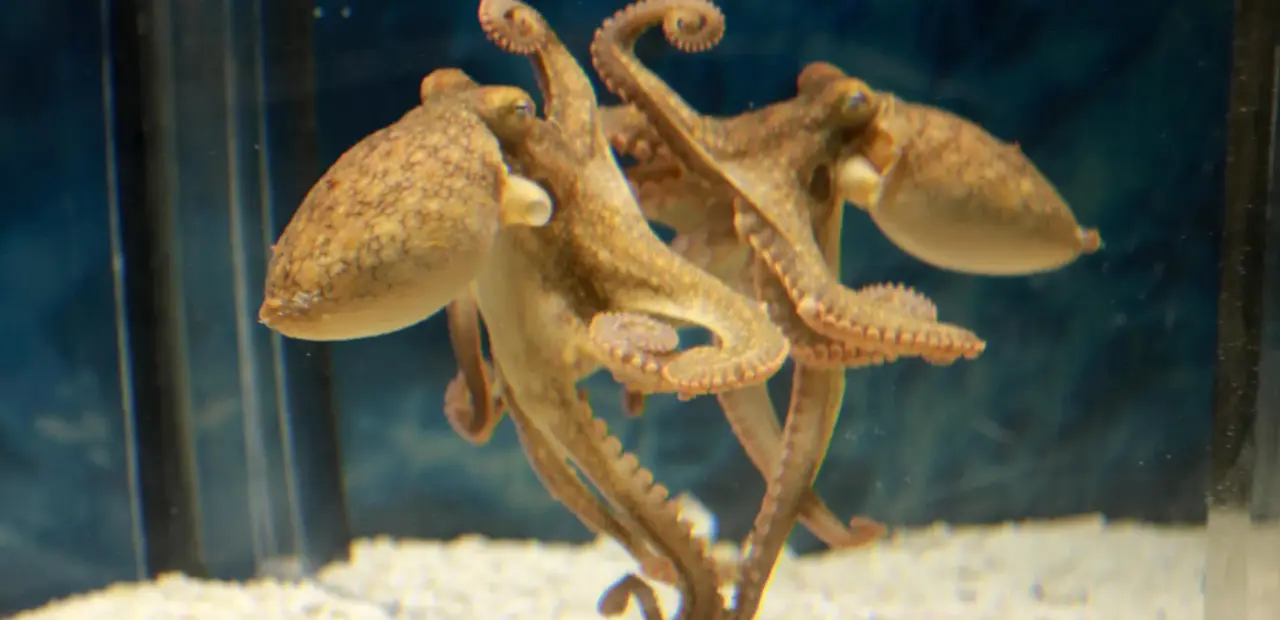
Researchers at Dartmouth College have found that octopuses can learn to use mirrors to locate food hidden from direct view, a skill previously documented only in vertebrates such as mammals and birds. The study, published in Current Biology, worked with three California two-spot octopuses housed in Dartmouth’s Octopus Lab. After training, the animals correctly identified the food’s location about 73% of the time, demonstrating they could use a mirror as a tool rather than simply reacting to a reflection. The researchers used a virtual crab image during testing to avoid the animals using chemoreceptors to smell or taste real prey. The octopuses became faster at reaching the correct location as trials progressed, though they did not always choose the shortest path. The findings suggest that the cognitive processes involved may be subject to convergent evolution, as octopuses are among the most evolutionarily distant animals from humans. The team emphasized that more research is needed to determine whether octopuses maintain internal mental maps of their environment.
What’s reported
The study was conducted by researchers at Dartmouth College and published in Current Biology.
Three California two-spot octopuses (Octopus bimaculoides) were used in the experiment.
The animals learned to use a mirror to locate a food source hidden from direct view.
During testing, a virtual crab image was used instead of real prey to avoid chemoreceptor interference.
The octopuses chose the correct side about 73% of the time.
The animals became faster at reaching the correct location as trials progressed.
The last common ancestor of octopuses and humans was a worm that lived 350 to 500 million years ago.
Open questions
Whether octopuses truly maintain internal mental maps of their environment.
Key figures
Mary Kieseler, lead author, Guarini ’25, PhD student at Dartmouth (now postdoc at University of Fribourg)
Peter Tse, senior author, professor of psychological and brain sciences at Dartmouth
Sources: ScienceDaily