



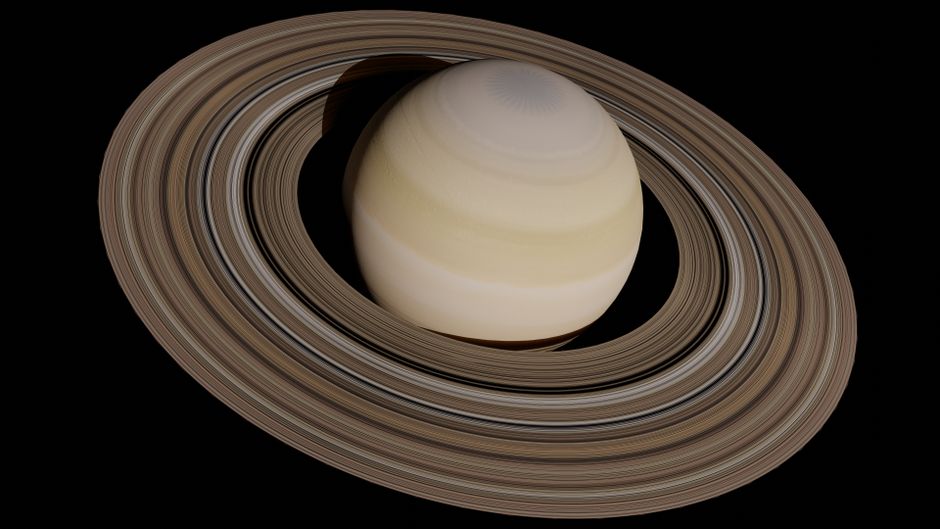
JWST reveals Saturn’s changing rotation was caused by auroral winds

The Story
Astronomers using the James Webb Space Telescope have resolved a decades-old mystery about Saturn. New findings published in the Journal of Geophysical Research: Space Physics show that Saturn’s apparent rotation rate changes were never real, but were caused by powerful winds high in the atmosphere driven by the planet’s aurora.
Key Facts
- Saturn’s apparent rotation rate was observed to change over time, which puzzled scientists because planets do not alter their spin on short timescales.
- A 2021 study by Professor Tom Stallard of Northumbria University proposed that electrical signals linked to Saturn’s aurora were being affected by atmospheric winds, making the planet appear to spin differently.
- JWST observed Saturn’s northern auroral region for an entire Saturnian day, creating the most detailed maps of temperatures and charged particle densities in the region.
- The observations were about ten times more precise than earlier measurements, which had uncertainties of roughly 50 degrees Celsius.
- The data matched computer model predictions that required the heating source to be located exactly where the strongest auroral particles enter the atmosphere.
- Energy from the aurora heats the atmosphere, generating winds, which create electrical currents that power the aurora, forming a self-sustaining cycle.
- Lead researcher Professor Tom Stallard described the process as “essentially a planetary heat pump.”
- The study involved researchers from Northumbria University, Boston University, the University of Leicester, Aberystwyth University, the University of Reading, Imperial College London, Lancaster University, and Johns Hopkins University Applied Physics Laboratory.
- Funding was provided by the Science and Technology Facilities Council (STFC).
Conflicting Reports
No conflicting reports identified in the source article.
Still Unclear
No open questions identified in the source article.
Misconceptions
No widespread misconceptions addressed in the source article.
Key Figures
- Professor Tom Stallard of Northumbria University — lead researcher
- Researchers from Northumbria University, Boston University, University of Leicester, Aberystwyth University, University of Reading, Imperial College London, Lancaster University, and Johns Hopkins University Applied Physics Laboratory (specific individuals not named beyond Stallard)
- Other named authors in journal reference: Luke Moore, Henrik Melin, Chris G.A. Smith, Omakshi Agiwal, M. Nahid Chowdhury, Rosie E. Johnson, Katie L. Knowles, Emma M. Thomas, Paola I. Tiranti, James O’Donoghue, Khalid Mohamed, Ingo Mueller-Wodarg, John C. Coxon, Sarah V. Badman, Joe A. Caggiano
Sources: ScienceDaily