



Amazon Deploys New Quasi-Random Networking Design in Data Centers

The Story
Amazon says it has achieved a breakthrough in networking design using a “quasi-random” approach, deploying the technology in its data centers since late last year. The company claims significant improvements in data speed and energy efficiency, with a new device called the ShuffleBox that automatically shuffles cables. A paper detailing the design, titled “RNG: Flat Datacenter Networks at Scale,” was published last month.
Key Facts
- Amazon’s new design uses resilient network graphs (RNG) that combine elements of structured and random networks.
- The company deployed the first RNG instance in a Dublin data center in 2024, then expanded to Germany and Spain.
- Amazon claims the design uses 69 percent fewer routers and switches, delivers 33 percent higher data throughput, cuts network power consumption by 40 percent, and lowers operating costs by 27 percent.
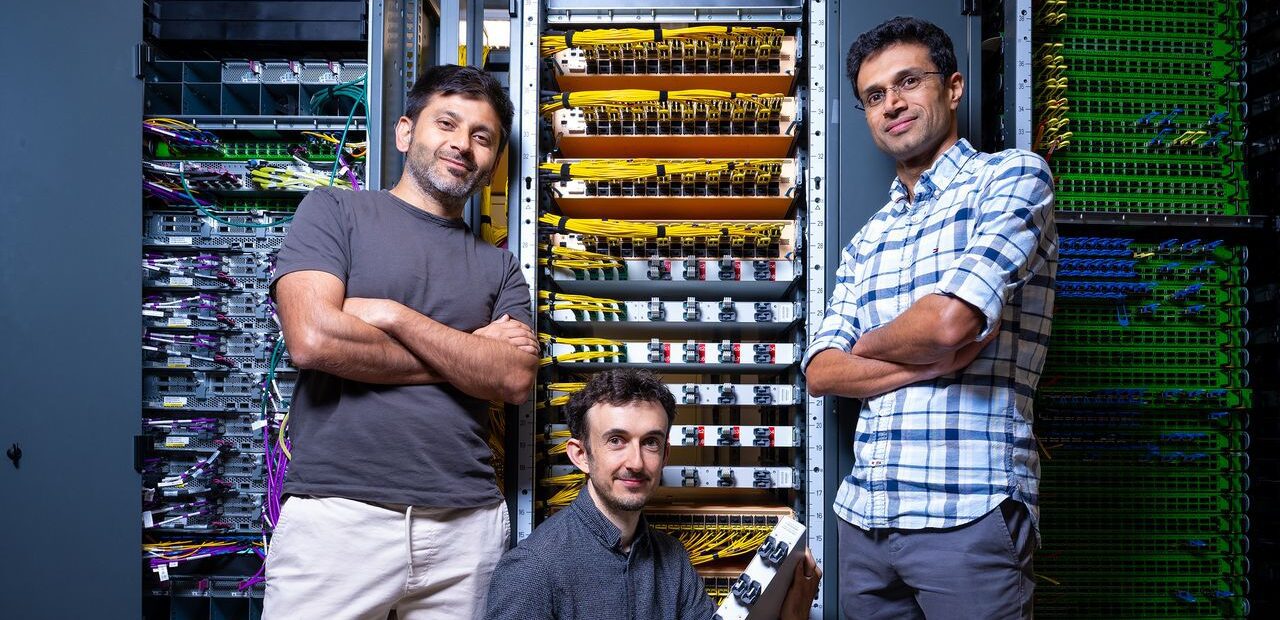
- A new optical device called the ShuffleBox mixes connections between routers internally.
- Amazon’s global data centers are currently connected with 20 million kilometers of fiber-optic cables.
- “RNG is a great fit for our core demands, but AI training data patterns are far more coordinated and centrally orchestrated, so they don’t approximate a random graph,” said Matt Rehder, AWS vice president of network engineering.
Conflicting Reports
No conflicting reports identified in the source article.
Still Unclear
No open questions identified in the source article.
Misconceptions
No widespread misconceptions addressed in the source article.
Key Figures
- Brighten Godfrey, computer science professor at University of Illinois Urbana-Champaign and networking expert (not involved in Amazon’s research)
- Matt Rehder, vice president of AWS Network Engineering
- Giacomo Bernardi, lead author on the RNG paper and Amazon employee
- Ratul Mahajan, Amazon Scholar and co-author
- Seshadhri Comandur, Amazon Scholar and co-author
- Roger Penrose, British physicist (mentioned as namesake of Penrose tiling, which researchers tried but abandoned)
Sources: Wired