



Physicists demonstrate black hole energy extraction in lab experiment

6 reported
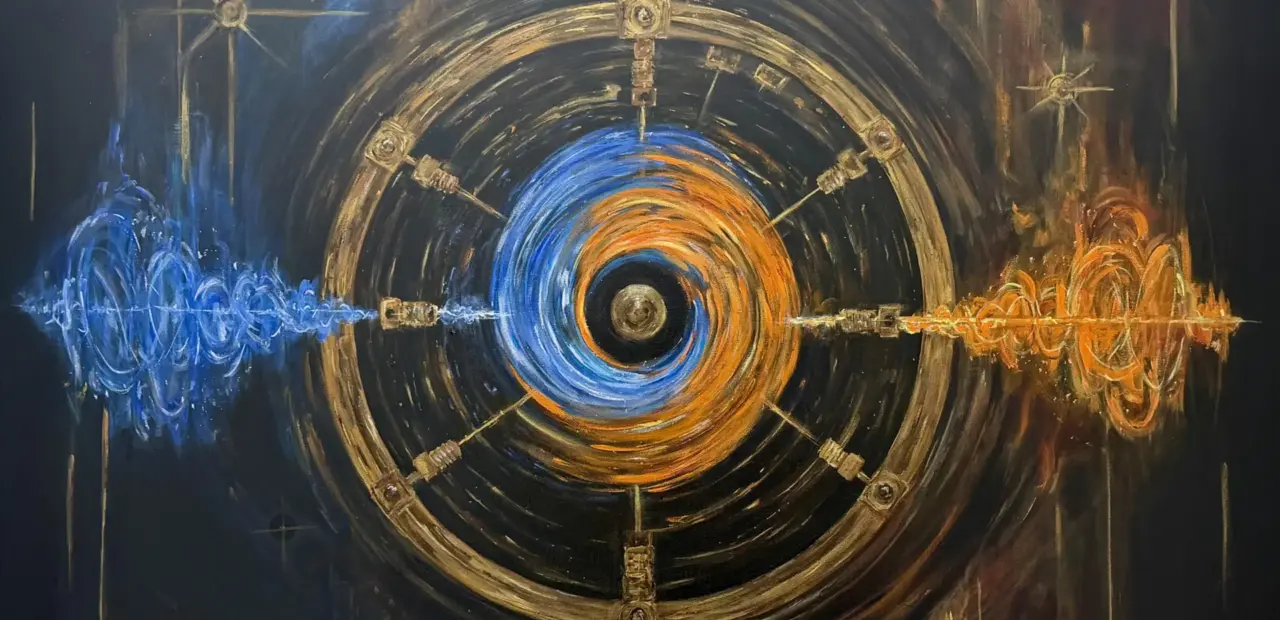
Researchers at the Advanced Science Research Center at the CUNY Graduate Center have demonstrated an experimental approach inspired by theories from physicists Sir Roger Penrose and Yakov Zel'dovich about extracting energy from a spinning black hole. Writing in the journal Nature, the team showed that wave amplification can be achieved using a device that simulates extreme rotation without physically spinning. The researchers built a radio frequency device whose properties are rapidly changed across both space and time, creating the illusion of ultrafast rotation. The experiment transforms a long-standing theoretical concept into a practical research tool, according to the researchers. The work has implications for advances in fundamental science and in communications, optics and photonics. The research was supported by the U.S. Department of Defense, the U.S. National Science Foundation, and the Simons Foundation.
What’s reported
More than 50 years ago, physicist Sir Roger Penrose proposed that energy could be extracted from a rapidly spinning black hole.
Physicist Yakov Zel'dovich later predicted that waves interacting with an object rotating fast enough could gain energy and become amplified.
Researchers at the CUNY ASRC demonstrated wave amplification using a stationary device that simulates extreme rotation.
The device is a ring of electronic resonators whose properties were rapidly adjusted in a synchronized sequence, creating a traveling pattern around the ring.
The experiment reproduces the essential physics of the Penrose-Zel'dovich process, according to the researchers.
The work was published in the journal Nature.
Key figures
Sir Roger Penrose, physicist
Yakov Zel'dovich, physicist
Andrea Alù, principal investigator, Distinguished Professor and Einstein Professor of Physics at the CUNY Graduate Center and founding director of the CUNY ASRC's Photonics Initiative
Hadiseh Nasari, lead author, post-doctoral researcher with the CUNY ASRC's Photonics Initiative
Hady Moussa, co-lead author, former PhD student with the CUNY ASRC Photonics Initiative
Sources: ScienceDaily