



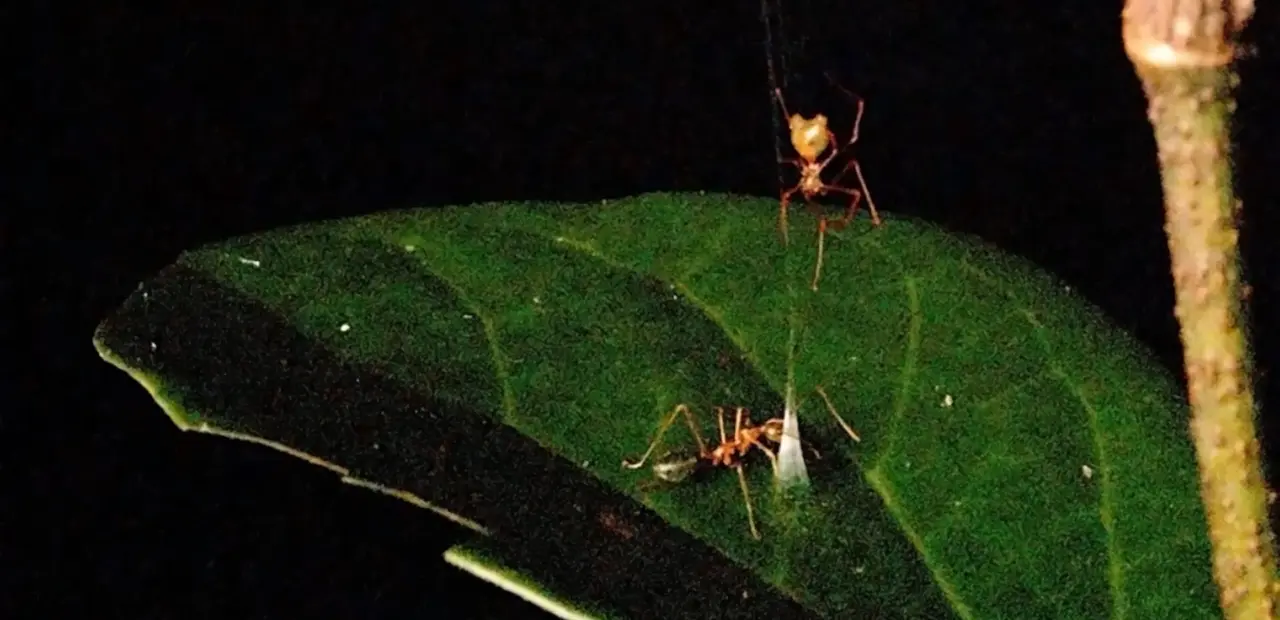
New Ballista Spider Uses Silk Catapult to Capture Green Tree Ants

8 verified6 unconfirmed1 contested
Researchers have discovered a spider in the rainforests of northern Queensland that uses a spring-loaded silk trap to capture a single prey species: the aggressive green tree ant. The small nocturnal arachnid has been informally named the ballista spider, after an ancient Roman siege weapon. Scientists from Macquarie University, led by Professor Ajay Narendra, observed the spider building a cone-shaped structure from 15 to 60 tensioned silk strands over several hours. When an ant approaches and bites the cone, it detaches the anchor, launching the ant more than 30 centimeters upward into the spider’s main web at an acceleration exceeding 1,300 meters per second squared. The spider then waits until the prey is fully trapped before wrapping it in silk. The study was published in Current Biology. Researchers believe the mechanism evolved as a specialized way to hunt dangerous prey while staying away from ant trails.
What’s verified
The ballista spider is a newly discovered species that builds a spring-loaded silk trap to capture green tree ants.
The spider belongs to the genus Propostira and has not yet been formally named.
Researchers from Macquarie University, led by Professor Ajay Narendra, conducted the study.
The trap is triggered when the ant accidentally detaches the cone, launching the ant upward into the spider's web.
The acceleration experienced by the ant exceeds 1,300 meters per second squared.
The spider spends up to four hours constructing the trap.
Most spiders avoid hunting ants because ants are dangerous and can recruit reinforcements.
The study was published in the journal Current Biology.
Where accounts differ
No direct contradictions were identified, but sources report slightly different acceleration values. One source states the acceleration exceeds 1,300 meters per second squared, while another gives a specific figure of about 1,360 meters per second squared.
Not yet confirmed
Only one source mentions that the spider uses a pheromone to specifically lure worker ants.
Only one source states that the spider was first spotted by Professor Greg Anderson.
Only one source reports that the spider is nocturnal and remains hidden during daylight hours.
Only one source specifies the number of tensioned strands in the trap as 15 to 60.
Only one source states that the ant survives the impact and that the hunting method has a 100% observed success rate.
The potential practical applications of the discovery, if any, are not detailed.
Key figures
Ajay Narendra: Professor of insect neuroethology at Macquarie University; lead researcher on the study.
Sources: ScienceDaily, NPR