



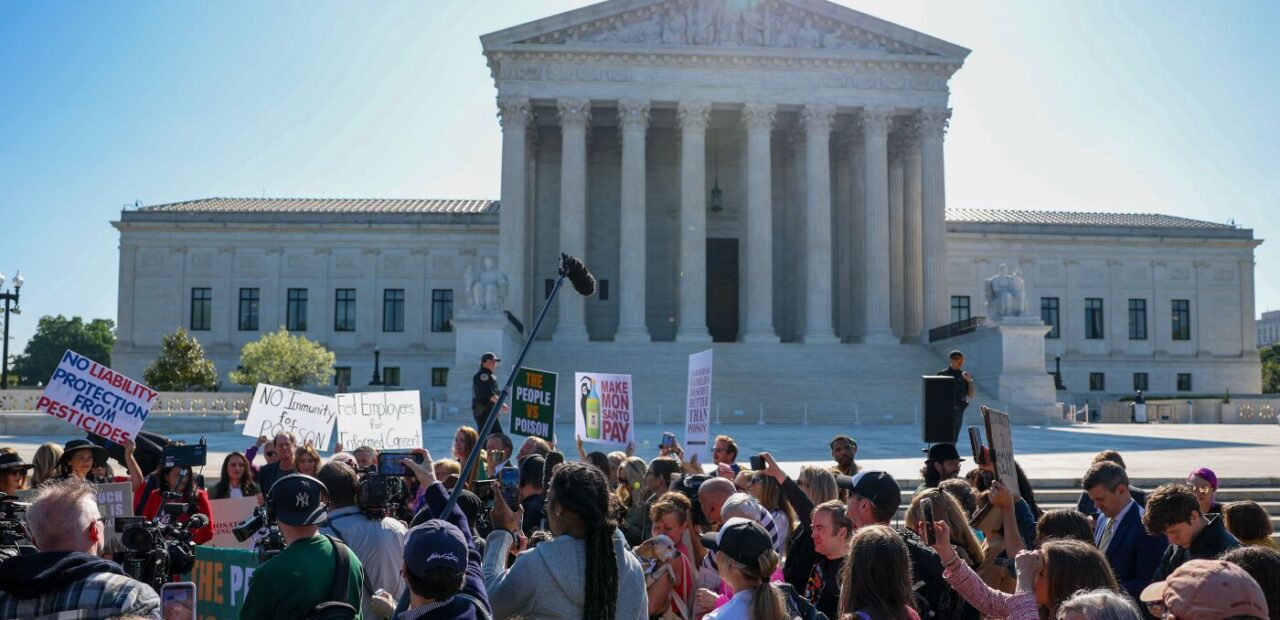
Supreme Court Rules for Roundup Maker in Cancer Liability Case

8 verified5 unconfirmed
The U.S. Supreme Court ruled in favor of Monsanto, now owned by Bayer, in a 7-2 decision that blocks thousands of lawsuits alleging the company failed to warn consumers about the cancer risks of its weed killer Roundup. The case centered on whether federal law, specifically the Federal Insecticide, Fungicide, and Rodenticide Act (FIFRA), preempts state failure-to-warn claims. Justice Brett Kavanaugh wrote the majority opinion, holding that because the Environmental Protection Agency approves pesticide labels, state court actions cannot impose additional labeling requirements. Justice Ketanji Brown Jackson dissented, arguing the majority misinterprets the law and leaves harmed plaintiffs without a remedy. The ruling is a victory for Bayer, which has faced a wave of litigation and previously set aside billions for settlements. The company has proposed a $7.25 billion class-action settlement to resolve many remaining claims, though it says it will continue to pursue that agreement. Bayer stated the decision provides regulatory clarity necessary for innovation and an affordable food supply.
What’s verified
The Supreme Court ruled 7-2 that federal law preempts state failure-to-warn claims against the maker of Roundup, shielding Bayer from liability in thousands of lawsuits.
The case was brought by Missouri resident John Durnell, who developed non-Hodgkin’s lymphoma after years of using Roundup.
Justice Brett Kavanaugh wrote the majority opinion; Justice Ketanji Brown Jackson dissented.
Bayer argued that FIFRA gives the EPA sole authority over pesticide labels, overriding state court actions.
The EPA has determined glyphosate, Roundup’s key ingredient, is not likely to cause cancer in humans when used as directed; the World Health Organization’s IARC classified it as “probably carcinogenic” in 2015.
A jury had previously awarded Durnell $1.25 million in damages.
The ruling is expected to block thousands of pending failure-to-warn lawsuits against Bayer.
Bayer has proposed a $7.25 billion class-action settlement to resolve many remaining claims.
Not yet confirmed
President Donald Trump signed an executive order aimed at boosting domestic production of glyphosate, which has created tension with some supporters of the Make America Healthy Again movement, according to a single report.
Approximately 200,000 Roundup-related claims have been filed against Bayer, mostly from home users, and Bayer has stopped using glyphosate in Roundup sold in the U.S. residential market, according to a single report.
Three states have passed laws shielding Bayer from liability in failure-to-warn lawsuits, according to a single report.
Health Secretary Robert F. Kennedy Jr. has repeatedly stated that glyphosate causes cancer while acknowledging the executive order’s necessity for food supply and national security, according to a single report.
The ruling could still allow other suits alleging problems with the product’s design, according to Durnell’s attorney Ashley Keller, as reported by a single source.
Key figures
John Durnell (plaintiff)
Justice Brett Kavanaugh (wrote majority opinion)
Justice Ketanji Brown Jackson (dissented)
Justice Neil Gorsuch (joined dissent, per one source)
Bayer CEO Bill Anderson
Ashley Keller (attorney for Durnell)
Paul Clement (former Solicitor General, Bayer’s attorney)
John Sauer (U.S. Solicitor General)
Christopher Seeger (claimants’ representative in settlement)
Jay Feldman (executive director of Beyond Pesticides)
Blake Hurst (corn and soybean farmer, former Missouri Farm Bureau president)
Patti Goldman (senior attorney at Earthjustice)
Robert F. Kennedy Jr. (Health Secretary)
President Donald Trump
Sources: NPR, statnews.com