



200-year-old light experiment used to create optical skyrmions for future computing

7 reported
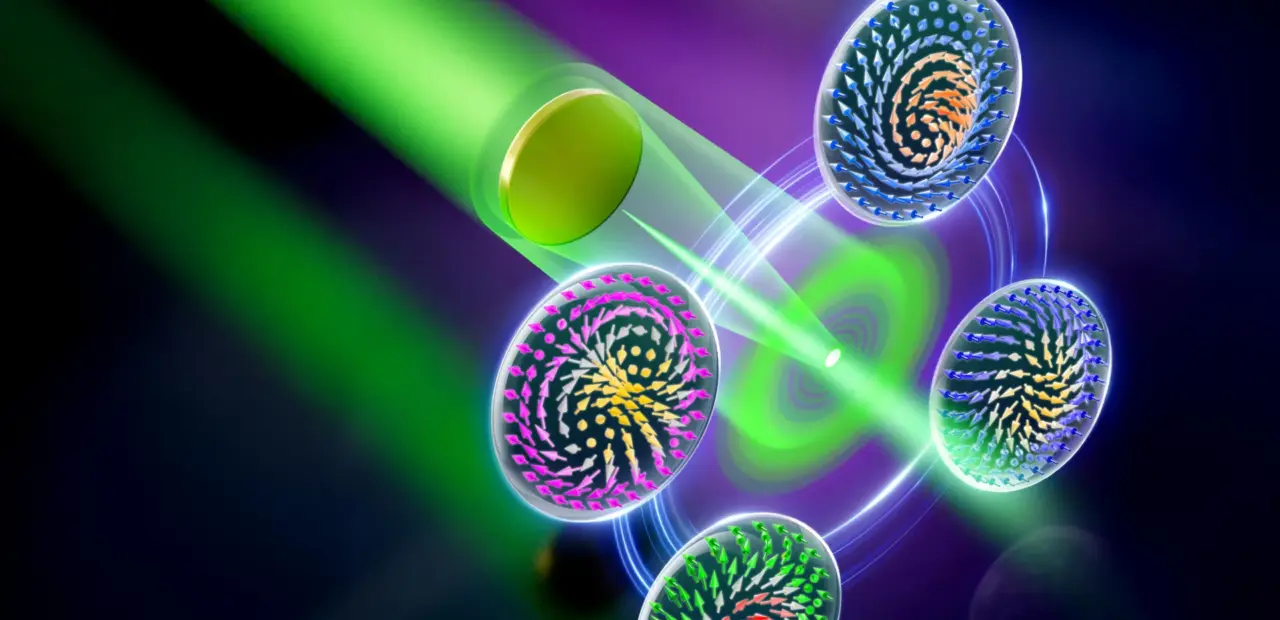
Scientists at Nanyang Technological University in Singapore have developed a simpler method to produce optical skyrmions, stable swirling patterns in light, by reviving a 200-year-old optical effect known as the Poisson spot. Instead of relying on expensive metamaterials, the team shined a laser at a small circular disc to generate these structures. The findings were published in the journal Optica and led by Nanyang Assistant Professor Shen Yijie. The Poisson spot, which produces a bright point in the center of a disc's shadow, historically provided evidence that light behaves as waves. The researchers discovered that their setup naturally produced four types of optical skyrmions simultaneously: spin, Stokes, electric field, and magnetic field skyrmions. Computer simulations showed the structures as swirling arrays of arrows. The team believes this method could make optical skyrmion research more accessible and contribute to advances in data storage, communications, and computing technologies.
What’s reported
Scientists at Nanyang Technological University, Singapore created optical skyrmions using the Poisson spot, a 200-year-old optical phenomenon.
The method involves shining a laser at a small circular disc, replacing expensive metamaterials.
The research was led by Nanyang Assistant Professor Shen Yijie and published in the journal Optica.
The Poisson spot is a bright point in the center of a circular object's shadow, demonstrating light diffraction.
The setup produced four types of optical skyrmions simultaneously: spin, Stokes, electric field, and magnetic field skyrmions.
Computer simulations showed the structures as swirling arrays of arrows.
Researchers see potential applications in data storage, communications, and computing technologies.
Key figures
Nanyang Assistant Professor Shen Yijie, from NTU's School of Physical and Mathematical Sciences and School of Electrical and Electronic Engineering.
Sources: ScienceDaily