



New catalyst triples CO2-to-methanol conversion rate

6 reported
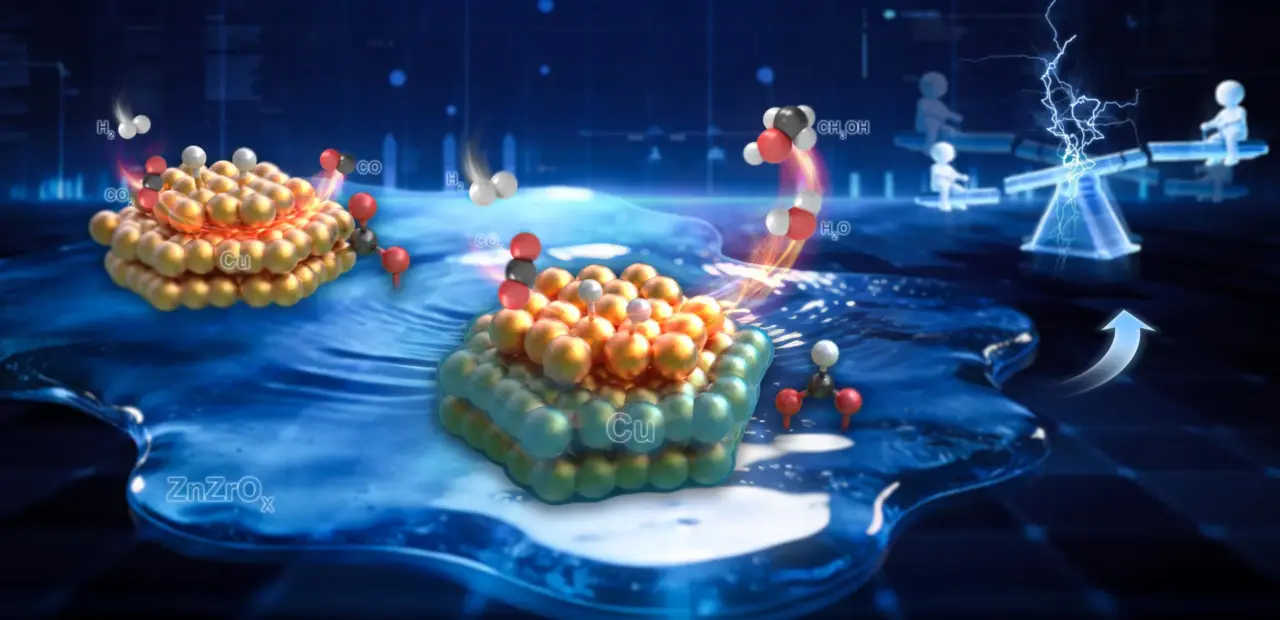
Researchers at the Dalian Institute of Chemical Physics, Chinese Academy of Sciences, have developed a new catalyst design that significantly improves the conversion of carbon dioxide into methanol. The study, published in Chem, addresses a long-standing trade-off between catalytic activity and selectivity that has limited methanol yields. The new design uses a strong metal-support interaction-driven overlayer structure to separate key reaction steps across different catalyst sites. This approach achieved a space-time yield of 1.2 g·gcat-1·h-1 at 300 ℃ and 3 MPa, approximately three times higher than conventional commercial Cu/Zn/Al catalysts. The catalyst encourages CO2 to activate on zirconia sites, steering the reaction toward methanol through the formate pathway and reducing carbon monoxide byproducts. Lead researcher Prof. Jian Sun stated that the study may provide a new pathway to addressing the trade-off between activity and selectivity in methanol synthesis from CO2.
What’s reported
The study was published in Chem and led by Prof. Jian Sun and Prof. Jiafeng Yu of the Dalian Institute of Chemical Physics, Chinese Academy of Sciences.
The new catalyst design uses a strong metal-support interaction (SMSI)-driven overlayer structure to spatially separate active sites.
The catalyst achieved a space-time yield of 1.2 g·gcat-1·h-1 at 300 ℃ and 3 MPa.
This performance is approximately three times higher than that of conventional commercial Cu/Zn/Al catalysts.
The catalyst encourages CO2 to adsorb and activate primarily on zirconia (ZrO2) sites, steering the reaction toward methanol through the formate pathway.
The change in reaction mechanism reduces the formation of carbon monoxide byproducts while preserving the ability of Cu sites to dissociate H2.
Key figures
Prof. Jian Sun, researcher at Dalian Institute of Chemical Physics, Chinese Academy of Sciences
Prof. Jiafeng Yu, researcher at Dalian Institute of Chemical Physics, Chinese Academy of Sciences
Sources: ScienceDaily