



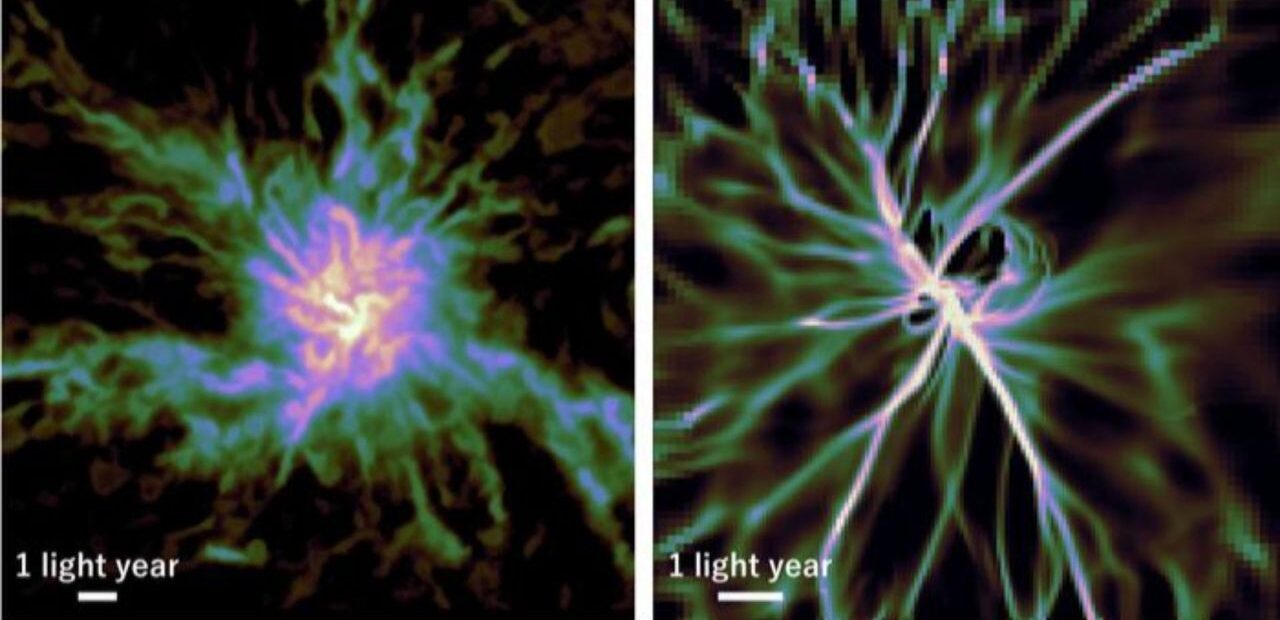
Shockwaves from dying stars may sculpt spoke-like stellar nurseries

Researchers from Kyushu University and Nagoya University in Japan used 3D simulations to investigate how shockwaves from stellar explosions and powerful stellar winds affect giant gas clouds where stars are born. The simulations, run on the ATERUI III supercomputer, showed that such shockwaves can carve out spoke-like filaments surrounding newborn stars, creating patterns known as hub-filament systems. Lead author Shingo Nozaki stated that stars form only in the coldest, densest parts of molecular clouds, where gas collapses under gravity. The team built a virtual molecular cloud threaded with magnetic fields and then subjected it to a simulated interstellar shockwave. Gravity first pulled the magnetic fields into an hourglass shape, then the shockwave created oblique shocks that amplified sections of the field, establishing pathways for gas flow. Over time, these channels funneled material into elongated filaments stretching toward a central hub, producing the observed spoke-like structures. The simulations also tracked how dense gas accelerates along filaments toward the hub while lower-density material remains still, potentially explaining why only a small fraction of gas in molecular clouds forms stars. The findings were published March 18 in The Astrophysical Journal Letters.
What’s reported
Researchers from Kyushu University and Nagoya University used 3D magnetohydrodynamic simulations.
The simulations recreated hub-filament systems, where shockwaves from dying stars carve spoke-like filaments in gas clouds.
Lead author Shingo Nozaki stated that stars form only in cold, dense parts of molecular clouds.
The team used the ATERUI III supercomputer dedicated to astronomical research.
Gravity first pulled magnetic fields into an hourglass shape, then a simulated shockwave created oblique shocks that amplified field sections.
Dense gas flows along the filaments and accelerates toward the hub; lower-density gas between spokes remains still.
This behavior may explain why only a small fraction of gas in molecular clouds forms stars.
The findings were published March 18 in The Astrophysical Journal Letters.
Open questions
Why hub-filament systems vary across the Milky Way remains unclear, according to the researchers’ plans for future work.
Key figures
Shingo Nozaki – lead author of the study, affiliated with Kyushu University.
Researchers from Kyushu University and Nagoya University.
Sources: space.com