



Hegseth Softens China Rhetoric at Shangri-La Dialogue Amid Trump-Xi Thaw

The Story
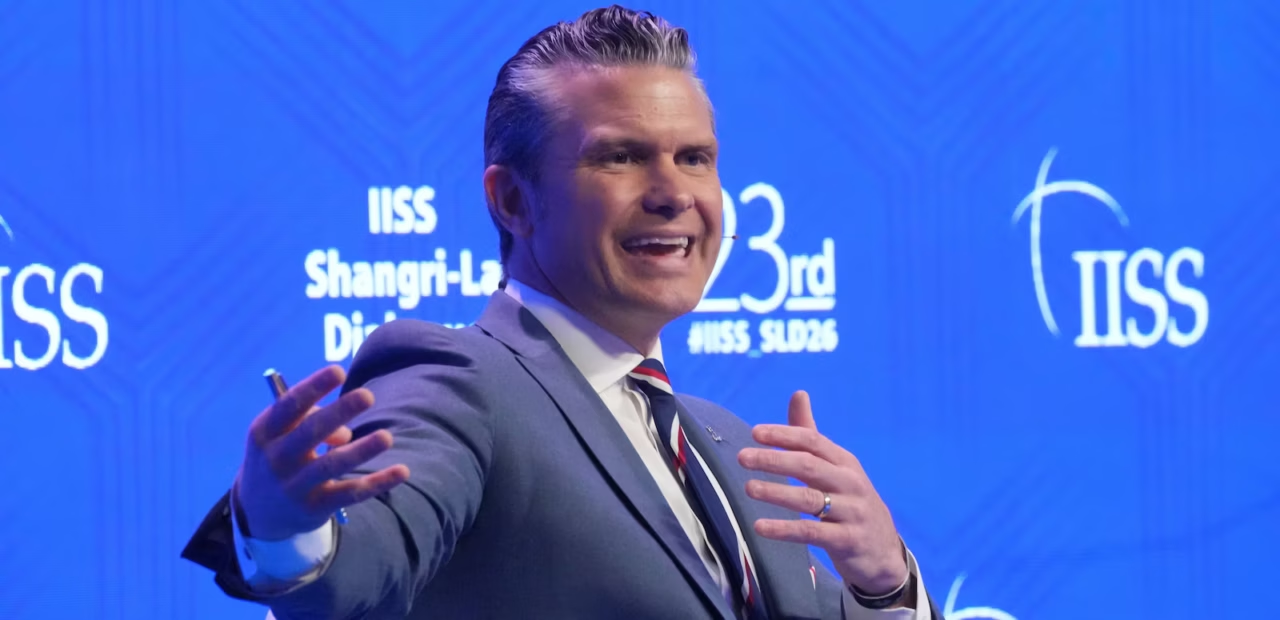
U.S. Defense Secretary Pete Hegseth addressed the Shangri-La Dialogue in Singapore on Saturday, assuring Pacific allies of Washington’s continued commitment to the region while softening previous warnings about China. His speech followed President Donald Trump’s mid-May meeting with Chinese President Xi Jinping in Beijing, where the two leaders agreed to pursue a “constructive relationship of strategic stability.” Hegseth called on Asian allies to increase defense spending, praising several countries including South Korea, the Philippines, and Australia for their efforts while criticizing European allies without naming them. Japan’s Defense Minister Shinjiro Koizumi criticized China’s military buildup and dismissed accusations of “neo-militarism,” while China’s delegate Major General Meng Xiangqing questioned Japan’s qualifications to discuss defense cooperation. Taiwan remained a key but unresolved topic, with Hegseth not directly mentioning the island in his speech this year. The conference also highlighted rising military spending across the Asia-Pacific, with regional expenditures increasing 8.1% to $681 billion in 2025.
Key Facts
- U.S. Defense Secretary Pete Hegseth spoke at the Shangri-La Dialogue in Singapore, toning down previous warnings about China and emphasizing U.S. commitment to the Pacific region.
- President Donald Trump met with Chinese President Xi Jinping in mid-May, and the two agreed on pursuing a “constructive relationship of strategic stability,” wording Hegseth used in his speech.
- Hegseth called on Asian allies to increase defense spending, praising South Korea, the Philippines, Australia, Singapore, Malaysia, Thailand, Vietnam, and India for their efforts.
- Japan’s Defense Minister Shinjiro Koizumi criticized China’s military buildup and lack of transparency, while China’s delegate Major General Meng Xiangqing accused Japan of failing to eradicate the legacy of militarism.
- Military spending in the Asia-Pacific rose by 8.1% in 2025 to $681 billion, according to the Stockholm International Peace Research Institute (SIPRI).
- Taiwan was a central but unresolved issue; Hegseth did not directly mention Taiwan in his speech this year, a shift from his previous strong warnings.
- Australian Deputy Prime Minister and Defense Minister Richard Marles spoke at the conference, agreeing with Vietnam’s President To Lam that security is linked to development.
- The International Committee of the Red Cross President Mirjana Spoljaric warned that massive weapons production and investment will lead to human loss.
Conflicting Reports
- Sources diverge on Hegseth’s handling of Taiwan: ABC News reports he said there was “no change in our status” toward Taiwan and would not comment on an arms deal, while DW.com states he did not mention Taiwan at all in his speech.
Still Unclear
- Chinese Defense Minister Dong Jun skipped the Shangri-La Dialogue for the second consecutive year (single-source claim, DW.com).
- Japan and South Korea are discussing a possible military-logistics deal, but South Korea’s Defense Minister Ahn Gyu-back said it requires caution and public persuasion (single-source claim, DW.com).
- Hegseth did not mention the wars in Ukraine or Iran in his speech (single-source claim, ABC News).
- Whether the $14 billion arms package for Taiwan, approved by Congress but put on hold by Trump, will proceed remains uncertain.
Misconceptions
No widespread misconceptions addressed in the sources.
Key Figures
- Pete Hegseth, U.S. Defense Secretary
- Donald Trump, U.S. President
- Xi Jinping, Chinese President
- Shinjiro Koizumi, Japan Defense Minister
- Meng Xiangqing, Chinese delegate (Major General)
- Richard Marles, Australian Deputy Prime Minister and Defense Minister
- To Lam, Vietnamese President and General Secretary
- Mirjana Spoljaric, International Committee of the Red Cross President
- Tammy Duckworth, U.S. Senator (Democrat, Illinois)
- Cui Tiankai, former Chinese Vice Foreign Minister
- Nils Hilmer, German State Secretary for Defense
- Ahn Gyu-back, South Korean Defense Minister
Sources: abcnews.com, dw.com