



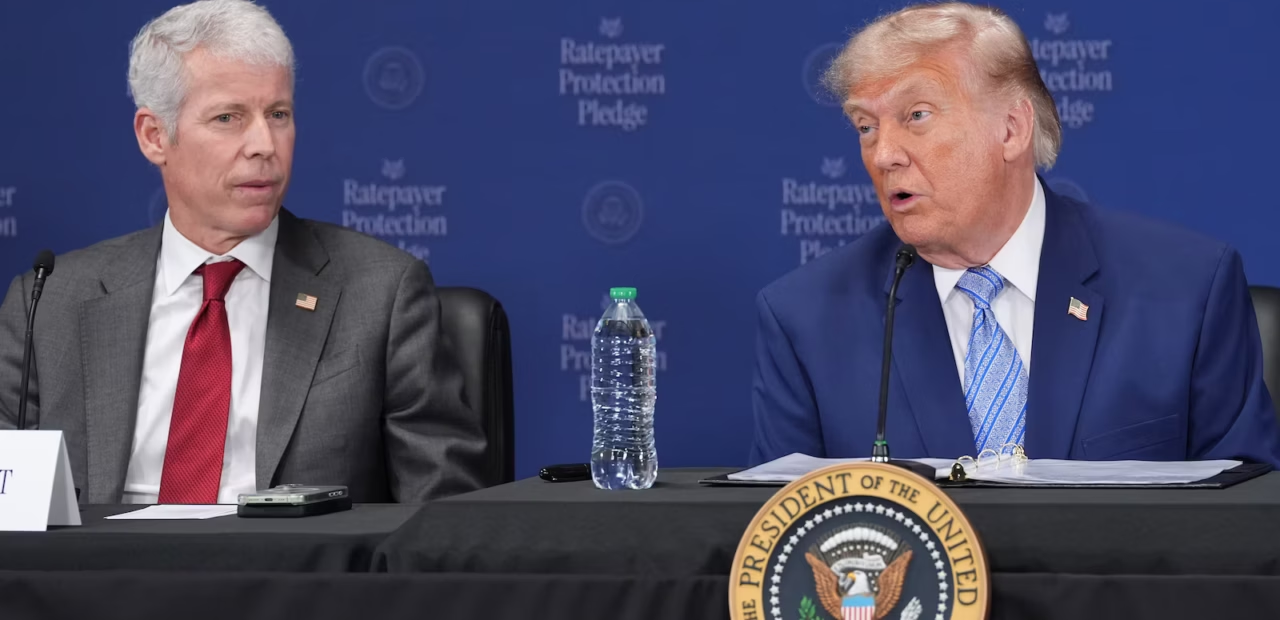
Trump Expands Voluntary Pledge to Keep Data Center Costs Off Household Bills

7 verified5 unconfirmed4 contested
President Donald Trump expanded his voluntary Ratepayer Protection Pledge on Thursday to include utilities, data center developers, and state governments, aiming to prevent consumers from bearing higher electricity bills driven by the AI data center boom. The pledge, first announced in March with major technology companies, is nonbinding and has been signed by numerous governors and companies. Trump, speaking at the Environmental Protection Agency, said electricity bills will come down as data centers generate their own power and contribute surplus to the grid. The expansion comes amid growing public opposition to data center construction over concerns about rising costs, environmental impact, and community changes. Original signatories include Amazon, Google, Meta, Microsoft, OpenAI, Oracle, and xAI. The White House stated the pledge now covers a significant portion of power delivered to American homes, though exact figures vary between reports. No enforcement mechanisms are specified in the pledge text.
What’s verified
President Trump expanded the voluntary Ratepayer Protection Pledge to include utilities, data center developers, and state governments.
The pledge is nonbinding and aims to prevent consumers from bearing the cost of data center energy demands.
Trump made the announcement in a speech at the Environmental Protection Agency.
The pledge was first announced in March 2026 with major technology and AI companies.
Original signatories include Amazon, Google, Meta, Microsoft, OpenAI, Oracle, and xAI.
Trump stated that data centers will generate their own electricity and that electricity bills for American families will come down.
There is growing public opposition to data center construction over concerns about utility costs, environmental impact, and community changes.
Where accounts differ
The number of signatories: One source reports 23 governors and at least 187 companies (including 55 utilities and 27 data center developers). Another source reports more than 200 additional utilities, data center developers, cooperatives, and states have joined. The exact count and categories are not consistent between reports.
One source includes a prediction from a consulting firm that utility bills could rise 15% to 40% by 2030; the other source does not mention this figure.
One source includes a White House complaint about a regional grid operator failing to implement principles; the other does not.
One source cites research predicting US data center capacity will double in three years; the other does not.
Not yet confirmed
One source stated the pledge now covers roughly 80 percent of power delivered to American homes and businesses, protecting 263 million people.
One source reported that the House Energy and Commerce Committee approved a bipartisan bill to require data centers to bear grid upgrade costs.
One source mentioned that some state legislatures and utility commissions have moved to require data centers to pay their own electricity costs.
One source reported that the pledge text contains no mention of enforcement or penalties for noncompliance, and the White House and EPA did not respond to questions about potential actions.
One source suggested that many data center operators were already generating their own on-site power before the president claimed responsibility for the idea.
Key figures
Donald Trump, President of the United States
Jensen Huang, CEO of Nvidia
Gina Hinojosa, Democratic nominee for Texas governor
Kathy Hochul, Governor of New York
Ron DeSantis, Governor of Florida
Matthew Freedman, staff attorney for the Utility Reform Network
Taylor Rogers, White House spokeswoman
John Dinsdale, chief analyst at Synergy Research
Sources: abcnews.com, theregister.com