



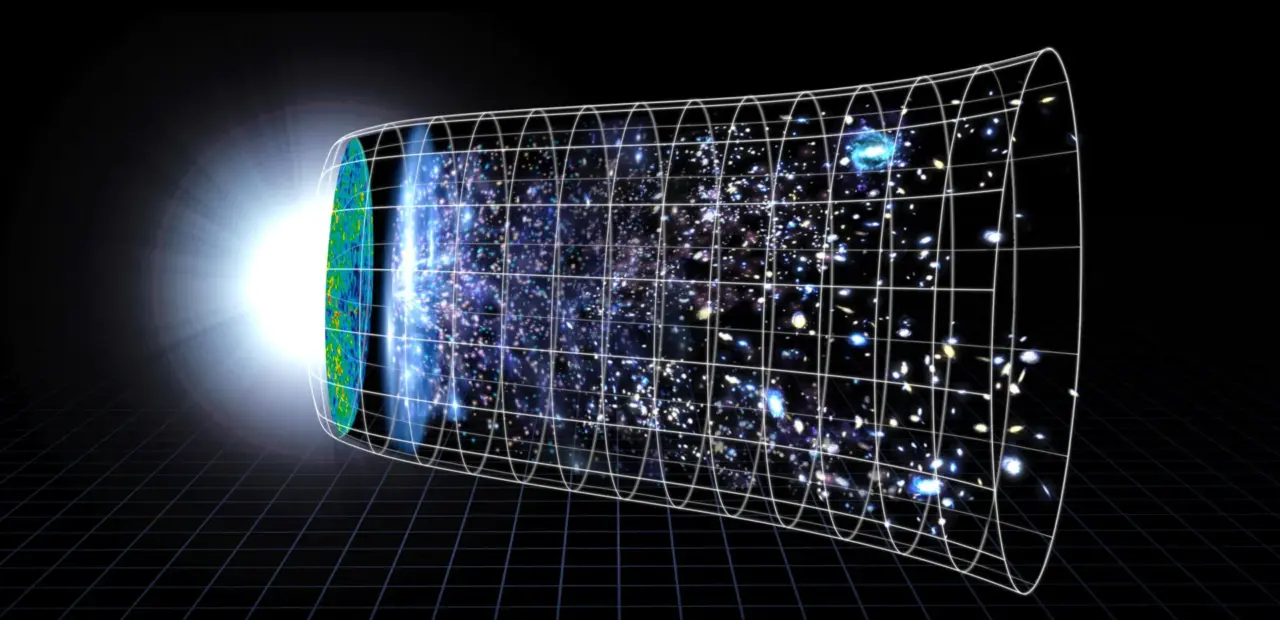
Cosmic expansion allows galaxies to outrun light, article says

5 reported
A new article from Universe Today explains that cosmic expansion allows distant galaxies to move away from Earth faster than light without violating Einstein’s laws. The article states that the speed of light limits how fast objects can move through local space, but cosmic expansion involves the growth of space itself, which is not restricted by special relativity. Astronomers use redshift measurements to estimate how quickly galaxies recede, with more distant galaxies generally moving away faster due to more intervening space. The observable universe extends about 45 billion light-years, despite the universe being only 13.77 billion years old, because space expanded while light traveled. The article notes that accelerating expansion driven by dark energy will eventually push nearly every galaxy beyond the Local Group out of sight, making the universe appear almost empty in about 100 billion years.
What’s reported
The universe is about 13.77 billion years old, but the most distant observable regions are now roughly 45 billion light-years away.
The speed of light limits how quickly objects move through space locally, but cosmic expansion is not subject to that restriction.
The Hubble distance, where galaxies begin receding faster than light, lies about 13.77 billion light-years away.
The cosmological event horizon is currently about 17 billion light-years away; light emitted now from beyond that boundary will never reach Earth.
In about 100 billion years, every galaxy beyond the Local Group will fade from sight.
Key figures
Paul Sutter, original writer of the article for Universe Today.
Sources: ScienceDaily