



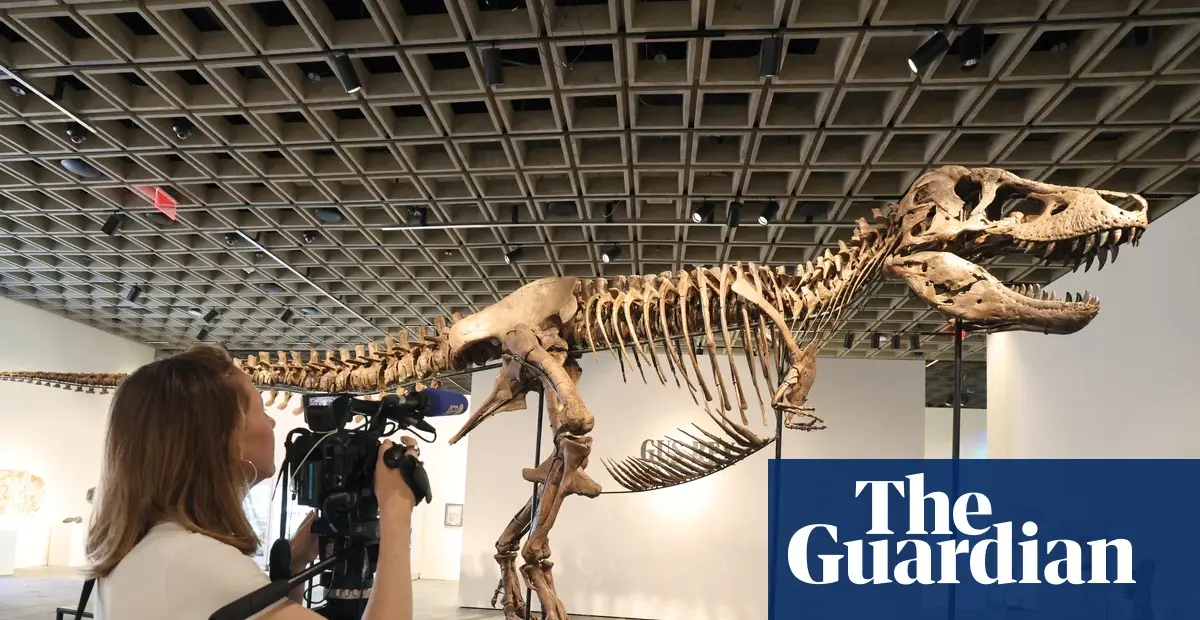
T. rex skeleton Gus expected to fetch up to $30 million at auction

7 verified6 unconfirmed
A 67-million-year-old Tyrannosaurus rex skeleton nicknamed Gus is set to be auctioned by Sotheby’s in New York on July 14, 2026, with an estimated sale price of $20 to $30 million. Discovered on a ranch in Harding County, South Dakota, in 2021, the fossil was excavated by Theropoda Expeditions over a three-year period. The skeleton stands about 12.5 feet tall and is described by Sotheby’s as one of the largest and most complete T. rex specimens ever found. It is named after the landowner, Gary “Gus” Licking, who died before the excavation was completed. Scientists have expressed concern that the high auction prices make it difficult for museums to acquire such fossils and that private ownership limits scientific research, as specimens must be permanently accessible for study to be published. Auction houses argue that commercial excavation can rescue fossils from erosion and that the prices reflect the specimens’ scientific importance. Previous notable Sotheby’s dinosaur auctions include Sue the T. rex, sold in 1997 for $8.4 million, and Apex the stegosaurus, sold in 2024 for $44.6 million to billionaire Ken Griffin, who later loaned it to the American Museum of Natural History.
What’s verified
The T. rex skeleton known as Gus is scheduled for auction by Sotheby’s in New York on July 14, 2026, with an estimated price of $20 to $30 million.
Gus was discovered in 2021 on a ranch in Harding County, South Dakota, and excavated by Theropoda Expeditions.
The skeleton is named after the landowner, Gary “Gus” Licking, who died before the excavation was completed.
Gus stands about 12.5 feet tall and is described by Sotheby’s as one of the largest and most complete T. rex specimens ever found.
Scientists have expressed concerns that high auction prices put fossils out of reach of museums and that private ownership limits scientific study, as specimens must be permanently accessible for research to be published.
Previous notable Sotheby’s dinosaur auctions include Sue the T. rex, sold in 1997 for $8.4 million, and Apex the stegosaurus, sold in 2024 for $44.6 million to billionaire Ken Griffin, who later loaned it to a museum.
Auction houses defend the sales, arguing that commercial excavation can rescue fossils from erosion and that the high prices reflect the specimens’ importance.
Not yet confirmed
The starting bid for the auction is reported as $19 million in a single source.
The skeleton’s length is given as 38 feet in a single source.
The degree of completeness is reported as 61% based on 183 fossil bone elements in a single source.
A single source reports that a 2025 study found more T. rex fossils in private collections than in public trusts.
A single source reports that paleontologists dispute Sotheby’s characterization of holes in the jaw as bite marks, suggesting they may instead be the result of infection.
None of the sources specify who the winning bidder is or whether the fossil will be donated to a museum after the auction.
Misconceptions
Some may believe that private collectors loaning fossils to museums is sufficient for scientific study. Scientists cited in multiple sources argue that such arrangements violate the need for permanent, guaranteed access for reproducibility, and that fossils must be held in public repositories on a permanent basis for research to be valid.
Key figures
Gary “Gus” Licking – landowner on whose ranch the fossil was discovered; died during excavation
Cassandra Hatton – vice chairman and head of the science and natural history department at Sotheby’s
Ken Griffin – billionaire who purchased Apex the stegosaurus in 2024 and loaned it to a museum
Sources: The Guardian, Wired, NPR