



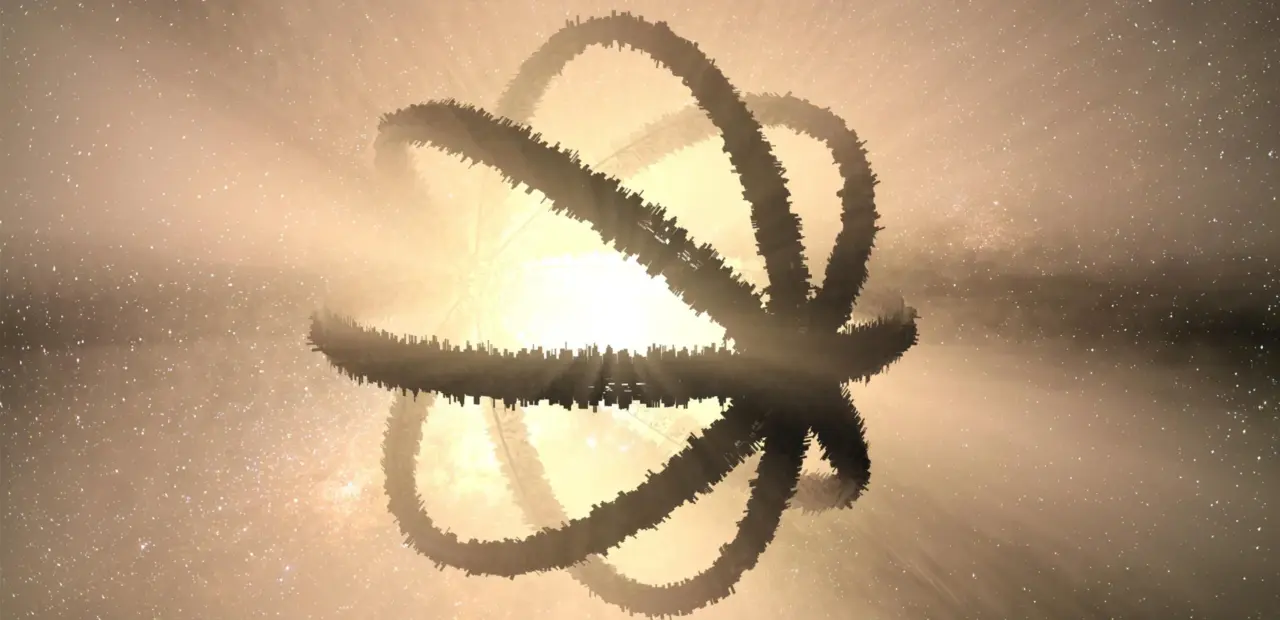
Study outlines how Dyson spheres could appear to telescopes

7 reported
A new study by Amirnezam Amiri of the University of Arkansas, currently available as a pre-print on arXiv and scheduled for publication in Universe, explores how hypothetical Dyson spheres might appear through modern telescopes. The research identifies red dwarfs and white dwarfs as the most promising stars to examine, since advanced civilizations could potentially build energy-harvesting swarms around them more easily. According to the study, a Dyson swarm would absorb virtually all of a star's radiation and re-emit it as infrared heat, making the object appear much colder than a natural star. The study predicts that such an object could have an effective temperature as low as 50K, around two orders of magnitude colder than a typical red dwarf. The James Webb Space Telescope is especially well suited to search for these structures because it specializes in infrared observations. In May 2024, researchers from Project Hephaistos reported seven promising Dyson sphere candidates after examining a catalog of roughly 5 million stars, with one later ruled out, leaving five candidates deserving closer study.
What’s reported
The study is by Amirnezam Amiri of the University of Arkansas, available as a pre-print on arXiv and scheduled for publication in Universe.
Red dwarfs and white dwarfs are identified as the most promising stars to host Dyson swarms.
A Dyson swarm would absorb starlight and re-emit energy as infrared heat, making the object appear much colder.
A typical red dwarf has a surface temperature of about 3000K; a surrounding Dyson sphere could have an effective temperature as low as 50K.
No known natural stars occupy that region of the H-R diagram.
The James Webb Space Telescope specializes in infrared observations and is well suited for the search.
In May 2024, Project Hephaistos reported seven promising Dyson sphere candidates from a catalog of roughly 5 million stars; one was ruled out, leaving five candidates.
Key figures
Amirnezam Amiri, University of Arkansas (study author)
Freeman Dyson (physicist who proposed the concept in 1960)
Project Hephaistos (research group that reported candidates in May 2024)
Sources: ScienceDaily