



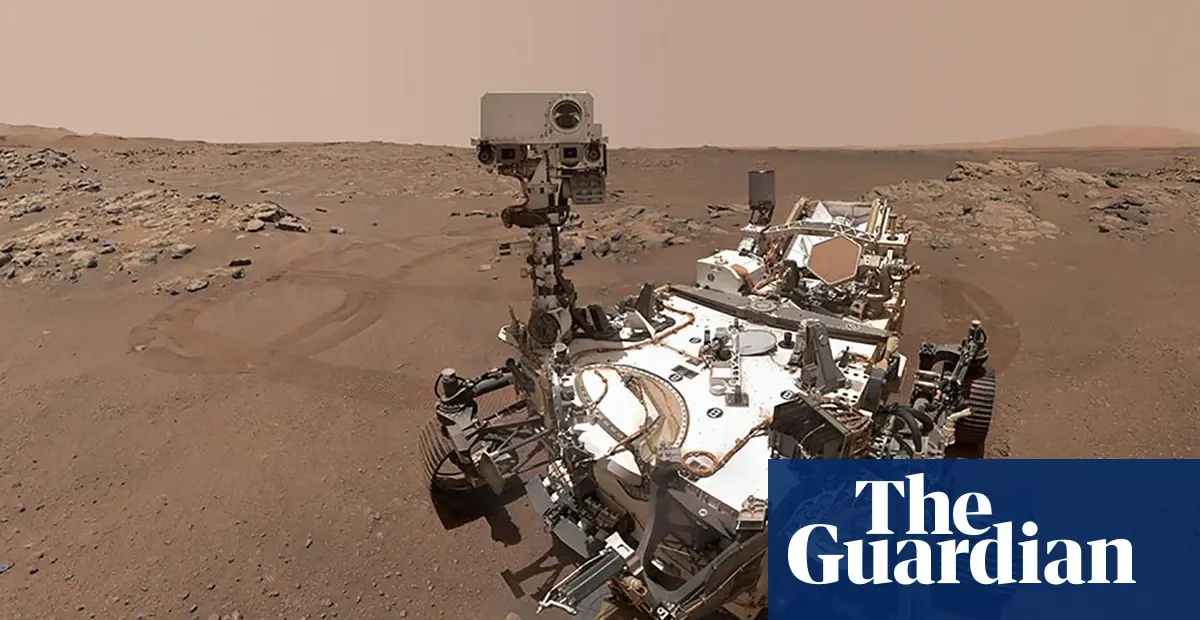
Perseverance Detects Organic Carbon on Mars, Adding to Signs of Ancient Life

6 verified3 unconfirmed
NASA's Perseverance rover has detected complex organic carbon molecules in Martian mudstones at the Bright Angel outcrop in Jezero Crater, according to a new study published June 24 in Science Advances. The rover's SHERLOC instrument identified macromolecular organic carbon (MMC) in two rocks, Cheyava Falls and Walhalla Glades, within a dried-up river delta that was once flooded with water billions of years ago. While MMC can originate from biological sources such as fossilized microbial mats, it can also form through geological processes like hydrothermal activity or arrive via meteorites, meaning the detection does not confirm past life. The findings are the first to identify intact MMC at multiple sites on the Martian surface and in mudstones, building on earlier detections by Curiosity in Gale Crater more than 2,000 miles away. Scientists say the discovery indicates that organic materials may have been widespread across ancient Mars, but determining whether they came from living organisms requires returning samples to Earth for laboratory analysis.
What’s verified
The Perseverance rover detected macromolecular organic carbon (MMC) in Martian mudstones at the Bright Angel outcrop in Jezero Crater.
The discovery was made using the SHERLOC instrument, which shines a laser on rocks and measures the scattered light.
MMC can form via both biological processes (such as fossilized microbial mats) and abiotic processes (such as water-rock reactions or impacts from meteorites).
The rocks in question—Cheyava Falls and Walhalla Glades—are mudstones from an ancient river delta that held water billions of years ago.
Previous analyses by the Curiosity rover also detected organic carbon in Gale Crater, indicating that organics may have been widespread across ancient Mars.
The study's authors state that returning Martian rock samples to Earth is ultimately required to determine whether the organic carbon came from ancient microbial life.
Not yet confirmed
One source reports that NASA’s planned Mars sample return mission was effectively scrapped in January 2026 and that a revised mission is now being planned for the 2030s; this detail is not mentioned by the other source.
One source notes that a colleague of the study authors said the findings are "the closest we’ve actually come to discovering ancient life on Mars," a quote attributed to the head of NASA science; the other source attributes a similar statement to the former acting head of NASA.
The exact distance between the Bright Angel detections and the earlier Curiosity detections is given as "more than 2,000 miles apart" by one source and "more than 3,500 kilometers (2,175 miles)" by the other, though the figures are consistent.
Key figures
Dr. Ashley Murphy (Planetary Science Institute)
Adrian Broz (Purdue University)
Dr. Kyle Uckert (NASA Jet Propulsion Lab)
Prof. Mark Sephton (Imperial College London)
Prof. John Bridges (University of Leicester)
Sources: The Guardian, eos.org